▲ 115 r/nikon_Zseries
Just crossed 10,000 shots with my Zf...a selection of favorites so far
u/Negative_Pace_5855 — 14 hours ago
No particular order, all sorts of glass used, this is simply my STFU and get out of the house camera. Glad I got one and did =)
Just FYI, due to the small front element diameter, you can very easily use a 58mm > 52mm step down ring and use 52mm filters on all 3 EVO lenses with 100% compatibility. I had standardized on 52mm for some older vintage lenses and was very pleased to find this out! Much happier to use an $8 adapter vs rebuying slightly larger filters.
Hey all, my last few recipes have trended towards that "filmic" look we are all addicted with lately, but I wanted to make a more "everyday" recipe that doesn't lean on faded shadows or overly warm tones in the highlights. Scott's Natura is a recipe that will accentuate the natural tones in your life without overpowering them.
Curious to hear how you like it!
File download and instructions here: https://www.scotttuckerphoto.com/blog/scotts-natura-recipe-for-nikon-z
Hey all, my last few recipes have trended towards that "filmic" look we are all addicted with lately, but I wanted to make a more "everyday" recipe that doesn't lean on faded shadows or overly warm tones in the highlights. Scott's Natura is a recipe that will accentuate the natural tones in your life without overpowering them.
Curious to hear how you like it!
File download and instructions here: https://www.scotttuckerphoto.com/blog/scotts-natura-recipe-for-nikon-z
A more toned down version of the often-too-frenetic bokeh of the 35 with just enough compression along with tons of microcontrast to make even an f4 shot pop.
Every evening I get a visit from the neighborhood fox as he makes his rounds. He’s got 3 kits right now that are very cute.
Came back to the series after a 3 year break after having played every version from 99 to 23. This gameplay model is atrocious.
- Defending is completely broken, including 2nd man press and contain
- Player switching more often than not causes the new player to run in the wrong direction or lose all momentum
- Essentially no new animations for any dead ball situation for the last 4+ years
- Every human opponent I've played in Seasons has no actual skill on the ball. No feints, no fake shots, no spins, no juggles or first touch power runs...nothing. They run straight at the goal past all of my stupid AI defenders and score untouched.
- AI forwards STILL don't make any sort of intelligent runs off the ball even in all out attack
The only thing I like is actually holding the ball, dribbling responsiveness seems improved as well as how early you can interrupt animations. Everything else is DIRE.
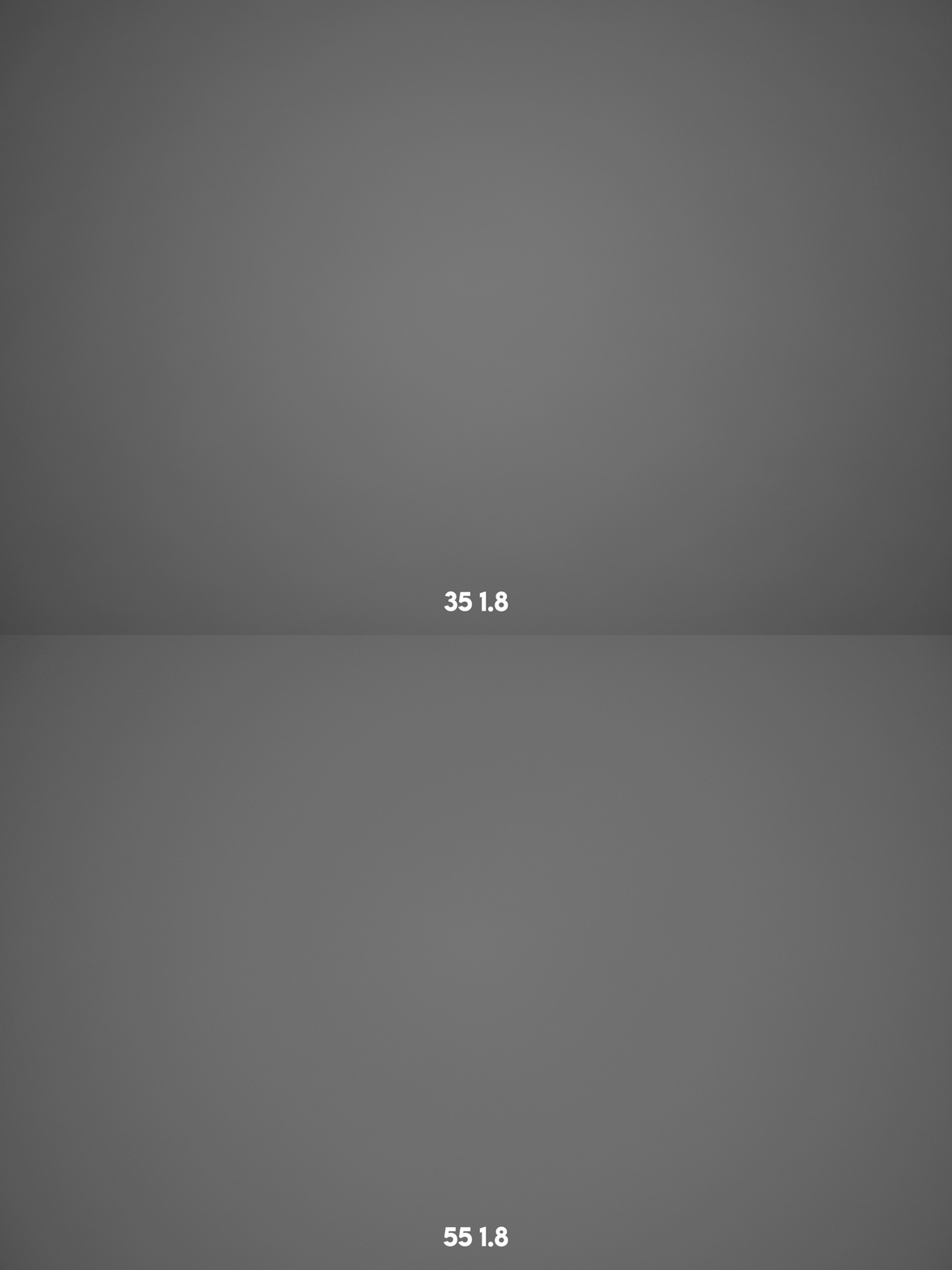
Thought some might like to see this, these are uncorrected files at f1.8, f2.8 and f4.0 on both EVO lenses. The 35 has significantly more vignette at all apertures, though the differences decrease as you move toward f8. I've noticed that the 35 at f1.8 exhibits a central "hot spot" which must be accounted for in composition if you are not planning on applying a correction profile in post (i.e. shooting JPEG in camera).
In practical real world shooting, I find that I am noticing and working around the 35's vignette far more than I am with the 55.
I was a little annoyed by all of the scaffolding and construction, so I fixed up the place myself =)
Some basic tests here to compare various aspects of the 55 EVO rendering and how it differs from the 50 APO-L many of us likely have experience with. All shots are 55 EVO first, 50 APO-L second.
All shots are unprocessed RAW, no lens profile corrections, with exposures normalized as much as possible with only changes to exposure slider. In most cases, the EVO metered about half a stop darker than the APO-L.
Set 1: close focus at f/2 on both - EVO renders a smoother, less frantic bokeh and provides a more balanced exposure thanks to considerably less vignette. The APO-L demonstrates a strong hotspot in the center of frame that tends to overexpose any highlights while the edges of the shot are underexposed because of the vignette.
Set 2: midrange focus at f/4 on both - EVO demonstrates slight barrel distortion, APO-L demonstrates a slightly more significant pincushion distortion. The APO-L is still showing more vignette at f/4 than the EVO is. The APO-L is showing some distortions in the bokeh at edge of frame where the EVO is not.
Set 3: midrange focus at f/8 on both - a naturally desaturated scene is usually good for demonstrating a lens' microcontrast. Both lenses are showing their particular type of distortion again. The center of the frame seems to go to the EVO with having slightly more sharp texture, but the edge of frame is FINALLY going to the APO-L with sharper hard lines (power lines in top left a good example).
Thoughts: I am WHOLLY impressed with the 55 EVO here. That it took the Voigtlander until F8 to catch up in any aspect was very surprising as the APO-L lenses are highly corrected and one of the best overall lenses for pure IQ on Z mount. The 55 EVO had more pleasant bokeh throughout the tests, a sharper center, and provided a more balanced metering and exposure of images. It has the weather sealing the APO-L lacks, and of course adds in the nicety of decent autofocus on top of everything.
Some basic tests here to compare various aspects of the 55 EVO rendering and how it differs from the 50 APO-L many of us likely have experience with. All shots are 55 EVO first, 50 APO-L second.
All shots are unprocessed RAW, no lens profile corrections, with exposures normalized as much as possible with only changes to exposure slider. In most cases, the EVO metered about half a stop darker than the APO-L.
Set 1: close focus at f/2 on both - EVO renders a smoother, less frantic bokeh and provides a more balanced exposure thanks to considerably less vignette. The APO-L demonstrates a strong hotspot in the center of frame that tends to overexpose any highlights while the edges of the shot are underexposed because of the vignette.
Set 2: midrange focus at f/4 on both - EVO demonstrates slight barrel distortion, APO-L demonstrates a slightly more significant pincushion distortion. The APO-L is still showing more vignette at f/4 than the EVO is. The APO-L is showing some distortions in the bokeh at edge of frame where the EVO is not.
Set 3: midrange focus at f/8 on both - a naturally desaturated scene is usually good for demonstrating a lens' microcontrast. Both lenses are showing their particular type of distortion again. The center of the frame seems to go to the EVO with having slightly more sharp texture, but the edge of frame is FINALLY going to the APO-L with sharper hard lines (power lines in top left a good example).
Thoughts: I am WHOLLY impressed with the 55 EVO here. That it took the Voigtlander until F8 to catch up in any aspect was very surprising as the APO-L lenses are highly corrected and one of the best overall lenses for pure IQ on Z mount. The 55 EVO had more pleasant bokeh throughout the tests, a sharper center, and provided a more balanced metering and exposure of images. It has the weather sealing the APO-L lacks, and of course adds in the nicety of decent autofocus on top of everything.
I tried to normalize the FOV (by taking the 55 image further away) as a way to investigate how each lens deals with bokeh...these are off the cuff and handheld approximations, certainly not scientific but they get the point across well enough.
Early days of testing, but I'm seeing that the 35 devolves into cat eyes MUCH faster across the frame than the 55. This leads to more frantic/busy bokeh on the 35. The 55 controls the bokeh shapes better and therefore has less jitter even when the near background is quite cluttered.
The 35 also seems to exhibit bright orbs within the bokeh sometimes that don't always materialize on other lenses, or even the 55. It seems VERY sensitive to any bright objects behind the subject. Overall, this contributes to the "background noise" of the 35.
For each example, the 35 is the first shot with the 55 after. It is obvious that by normalizing the FOV, the 55 will have a shallower depth of field/more bokeh, but this is instructional as an exercise positing that you'd be taking this photo with this FOV with either lens.
What are your thoughts?
11 frames of the International Space Station crossing the full moon, shot at 20fps, during a pass that lasted just over half a second. A little careful planning and a dash a luck go a long way! Looking forward to trying this again with the 180-600 some day.