r/TrueFilm

The multiple messages and themes in TAR (2022)

It has been a while since a movie has overwhelmed me with what it was trying to say. Normally, movies or stories in general would have one or two ideas that get focused on and developed with sprinkling of some smaller messages that support the main thing. TAR is one of the films that, to me, has multiple things being said all at once. So much that by the end of the movie, I was more so left in thoughts rather than in aww (which was the state I was in for the entire second half).

The Moral Ambiguity of Cancel Culture

One of the clearest through lines in Tár is its exploration of cancel culture, but what makes it interesting is how intentionally blurry it is. The film raises questions like “did the punishment match the crime?” and “are people too sensitive?” without ever giving a clean answer. A lot of what Lydia Tár is condemned for is either misinterpreted, exaggerated, or not entirely proven, yet the film never lets her off the hook as a person. That tension is what makes it compelling. It leaves you with the uncomfortable question: does it matter if someone is “cancelled” for the wrong reasons if they were still a terrible person anyway? There’s no definitive right or wrong here, just a morally grey space the film refuses to simplify.

The Myth of the Singular Genius (Auteur Theory)

Another major idea the film critiques is auteur theory—the tendency to over-credit a single individual as the genius behind a work. Tár operates in a field that is inherently collaborative, yet she is treated as the sole face of the art. When people talk about the music, it becomes “her” performance, even though it is the combined effort of musicians, engineers, and staff. The film subtly pushes back against this by showing how much invisible labor surrounds her. It questions the idea that greatness belongs to one person, especially when that person is standing on the work of many others. The movie pushed this point by rolling the credits at the beginning, forcing viewers to accept and understand that this is a collaborative effort with a long list of contributors, all of whom deserves praise and appreciation for their craft.

Losing and Rediscovering Passion

There is also a strong focus on passion, or more specifically, the loss of it. For most of the film, Lydia is not driven by her love for music but by politics, reputation, and control. She becomes consumed with navigating people, maintaining power, and managing her image. Her craft becomes secondary. It’s only near the end, when everything else is stripped away, that she reconnects with music in a genuine way. Returning to her roots and revisiting her idol reminds her why she started in the first place. Seen this way, the ending can be interpreted as somewhat hopeful—she may have lost prestige and status, but she is once again creating something meaningful and bringing enjoyment to others, even if it’s not in the same prestigious context.

Power, Control, and Self-Destruction

The film also heavily critiques the abuse of power. Lydia uses her position and reputation to shape situations in her favor, often disregarding the people around her. She acts with a sense of entitlement, assuming her status will shield her from consequences. Most of the obstacles she faces are ultimately self-inflicted. Her need to maintain control, silence threats, and preserve her image directly contributes to her downfall. She isn’t undone by a single event, but by a pattern of behavior rooted in selfishness and a belief that she is above accountability.

The Subjectivity of Music and Interpretation

Music itself is portrayed as an inherently subjective art form. Lydia makes decisions that others might see as obvious or objective, but her choices are clearly influenced by personal bias, including her attraction to certain individuals. This ties into the broader idea of art versus artist—how context, perspective, and personal feelings shape how we interpret art. The film suggests that what we hear is never entirely separate from who we are or what we know about the creator.

Separating the Art from the Artist

That naturally leads into the question of whether we can separate the art from the artist. The student at the beginning presents flawed arguments, but the core question still stands: should we continue to appreciate art if its creator is a terrible person? The film doesn’t answer this directly, but instead presents it as an ongoing tension. Lydia’s work is undeniably powerful, yet her character complicates how we engage with it.

Classism and Gatekeeping in the Music World

Classism within the music industry is another underlying theme. Lydia’s rise wasn’t purely based on talent; she relied on connections, particularly through her partner, to navigate elite spaces. The film shows how those already in positions of power have disproportionate control over what is considered valuable or “high” art. There’s also an implicit critique of how certain types of music are treated as inherently superior. In reality, music’s purpose is to make people feel something, and no form is objectively better than another—it ultimately comes down to personal preference.

The Fragility of Human Connections

Finally, the film says a lot about human connections and how easily they can be neglected. Lydia’s success is built on relationships, yet she gradually loses sight of that, prioritizing herself over the people around her. She damages relationships with those who support her, including her assistant and her partner, while aligning herself with people who don’t truly care about her. In the end, the most devastating loss isn’t her career, but her relationship with her daughter—the one connection that seemed genuinely meaningful to her.

Before I end, I would like to say that I appreciate the movie for leaving viewers with many questions even after it ended. "How true were the accusations?" "How guilty was Lydia?" "What was the movie trying to say with that ending?". There are no definitive answers to everything in this movie and I think that is great.

This movie is a 5/5 for me. It manages to say a lot about its characters and the world while also being a very gripping and interesting story, especially throughout the second half. I have to admit that I never noticed the ghost, the haunting, or the symbols people keep mentioning when they say how scary this movie was but that is probably just me not being focused enough (and being in a too-bright room while watching). Otherwise, this movie lived up to my expectations.
reddit.com
u/Future-Poetry-2193 — 23 minutes ago
🔥 Hot ▲ 68 r/TrueFilm

Just watched Marty Supreme. My thoughts on it

I know I'm late to the party, but glad I finally watched it. It is very interesting. In fact, I would go as far as to say that this is the best film of 2025 for me. How it was snubbed at the Oscars is beyond me. I think Chalamet as Mouser was nothing short of incredible, the nuance, the emotions, the drama, everything was so natural.

There's always an inherent tension and chaos in any Safdie film and this is no different. In fact, I would rate it at the same level as Uncut Gems. The main reason I really like it and relate to it because I myself have played a bit of professional table tennis in my college. And to say the least, all the table tennis scenes were done really well. Very happy to see the sport getting some representation in films as well.

Talking about the cinematography, it is special, especially that chase sequence when he tries to run with the bag of money from the policeman. The streets and the sets recreate the 50s New York atmosphere beatifully.

What I found the most interesting was the choice of the kind of music used in the soundtrack. Most of the tracks are soft rock or blues songs from the 80s/90s, event though the film is based in 50s. In the opening sex scene, Forever Young by Alphaville is played. I would never have thought to use a song like that in a sex scene, I found it a bit off-putting and unnatural, but interesting.

Finally, the ending. I think many people have misread the ending as Marty finally achieving his ambition and then coming back to see his wife & child thinking I have conquered the world. But I feel its exactly the opposite. The man is a huge narcissist, and will go to any length to get his game of table tennis against Endo (literally leaving his injured pregnant girlfriend in the hospital). But all the people he has done wrong, all the screw ups that he did, all the people he betrayed throughout to get the money for the championship, in the end it is all in vain. He never gets to play the championship. He just somehow half-assed his way to Japan, realizing in the end he will have to settle for just an exhibition match. And that shows in the end, after he arrives back at the hospital. We don't see his cocky demeanour instead he cries like a baby. That just shows the realizationt that he arrived at. The baby and the mother are the true meaning he is looking for. Not obsessive ambition. He had to literally beg his way to Japan (don't get me started on that Rockwell scene). But I think you do get the point.

Anyways, I think I made this too long. Lemme know what you guys thought of it, would love to hear some fresh takes.

P.S.

A24 is producing some absolute bangers since the comeback. Kudos

reddit.com
u/DD_PUNISHER — 18 hours ago

Casual Discussion Thread (April 06, 2026)

General Discussion threads threads are meant for more casual chat; a place to break most of the frontpage rules. Feel free to ask for recommendations, lists, homework help; plug your site or video essay; discuss tv here, or any such thing.

There is no 180-character minimum for top-level comments in this thread.

Follow us on:

The sidebar has a wealth of information, including the subreddit rules, our killer wiki, all of our projects... If you're on a mobile app, click the "(i)" button on our frontpage.

Sincerely,

David

u/AutoModerator — 13 hours ago

How Do You Live? in a Time of War: a discussion of The Boy and the Heron (2023) and its source

Note: this is an essay I published elsewhere. I am reproducing it here without a link, so as to avoid the semblance of self promotion. If you are interested in my other writing, you can just search this text.

Warning: This article discusses major plot developments in Genzaburō Yoshino’s How Do You Live? and The Boy and the Heron by Studio Ghibli. Significant spoilers follow.

“I know it’s a lie, but I have to see.”

— Mahito, The Boy and the Heron

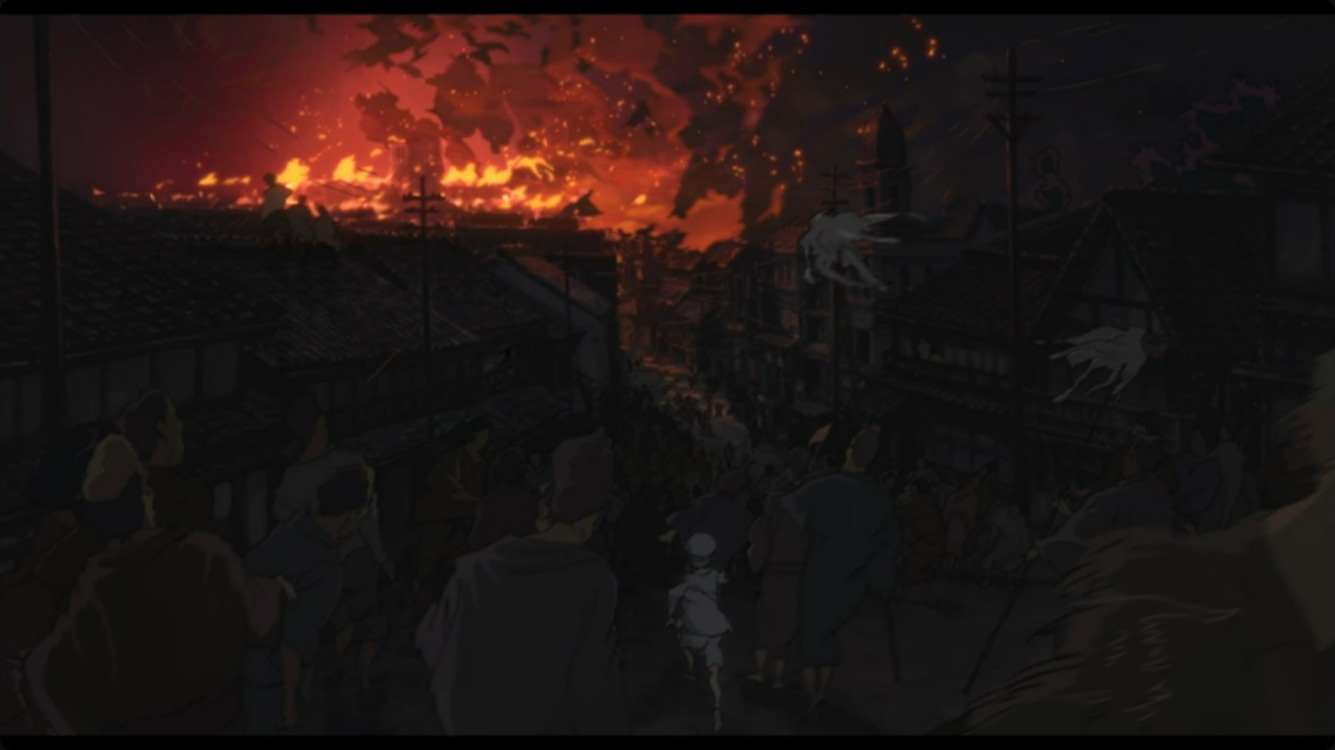
The scene begins with blaring sirens cutting through the night air. Their rising pitch crosses the clang of a distant alarm. A boy gets out of bed and hastily changes from a kimono and wooden sandals to more practical clothes. Smoke drifts along the street in shifting layers, carrying the heat of a blaze already out of control. Through the haze, flames climb up the facade of a hospital. Windows burst outward as embers scatter into the wind. At the edge of the crowd, the boy sprints forward until hands pull him short. He stands before the inferno, held in its light, unable to move closer or withdraw.

The fire dims into memory as the image darkens. Into the stillness, a voice enters: “Three years into the war, Mother died. And a year later, my father and I left Tokyo.”

Hayao Miyazaki’s final film, The Boy and the Heron, was originally released in Japan under the title Kimitachi wa Dō Ikiru ka, which translates as How Do You Live? The title comes first from Genzaburō Yoshino’s 1937 novel, which Miyazaki says he wept reading as a boy and which Miyazaki alludes to in the course of his film. The novel follows a junior high student in Tokyo named Junichi “Copper” Honda, who moves through the ordinary crises of adolescent life. After the death of his father, the boy is guided by his uncle’s letters, which ask him, again and again, to consider what it means to act with integrity in a world held together by mutual dependency.

I came to Yoshino’s novel through the film. I came to both again in Lebanon, in the spring of 2026, living and teaching in a city that was and is being bombed. It is Holy Week as I write this, and the question the novel puts to its reader—“How will you live?”—feels less like a literary provocation and more like the kind of question that only makes sense when everything around you is uncertain. This essay is my attempt to think through what happened when I read it here.

* * *

Lebanon’s safety collapsed fast in the spring of 2026 after the United States and Israel began their war with Iran. Hezbollah dragged Lebanon into the conflict, and Israeli strikes began in the south of the country and in Beirut’s southern suburbs. Within days, the strikes had reached more and more neighborhoods where thousands of families displaced from the south had taken shelter, believing the worst was behind them. Schools became sleeping quarters and the crisis worsened. Most of Lebanon’s youth, including my students, have grown up through economic collapse, experienced the aftermath of the 2020 port explosion, and are now accumulating a second or third layer of memory defined by evacuation orders and the sound of jets overhead.

After a week of hostilities, I found myself reaching for some story I could liken my experience to. The first one that came to mind was The Lion, the Witch and the Wardrobe. What is easy to forget is that Lewis’s novel is framed by a wartime evacuation: the four Pevensie children have been sent from London to the countryside to escape the Blitz. Displaced and living in a strange house, it is from within that specific condition that they are able to escape into a fantasy world. Critics of fantasy tend to call it escapism, and I want to take that seriously before I reject it. In a shelter I visit down from my school, the children of displaced migrants play phone games and kick footballs in the courtyard. They play with each other. They laugh and have fun. That is an escape in its purest form, a brief and necessary interruption of fear. I would not take it from them.

But I do not think escapism is what fiction does best. I have come to think that stories ought to work less like an escape room and more like a flight simulator. In an escape room you seal yourself off: the locks turn, the outside world ceases to exist, you are briefly elsewhere. A flight simulator does the opposite. When a pilot climbs into one, she is not pretending that gravity does not exist. She is voluntarily entering a space where the crisis is real enough to train on, precisely so that when she encounters it in the actual cockpit, she does not freeze. Where that analogy cracks is that I am standing in a classroom outside Beirut working out what fiction does for children in wartime, and the planes I am using as a metaphor are the same planes I can hear overhead.

What I keep arriving at is this: the most important thing fiction does is give us the chance to live lives that are not our own. Not metaphorically, but in some genuine and irreducible sense, to inhabit another consciousness and feel the weight of another person’s choices. The Pevensie children, rather than just surviving Narnia, become people who have been kings and queens. They have carried grief and responsibility in a world other than this one, and they bring all of that back when the wardrobe closes. That expansion is not preparation for anything in particular. It is an enlargement of what it is possible to be.

In Yoshino’s novel, the uncle makes a distinction that is worth returning to. There are things that can be taught, he tells Copper, and there are things that cannot be taught. Chemistry, grammar, and algebra can be explained in words and transferred from one mind to another. But the taste of cold water can only be understood by drinking it. The color red can only be known by someone who has seen it.

>

Fiction is one of the few mechanisms we have for manufacturing that kind of encounter with lives we will never directly live.

* * *

The publication of How Do You Live? is itself a minor act of courage: Yoshino wrote it as the final entry in a series intended to bring progressive ideas to young Japanese readers at precisely the moment when such ideas were being suppressed by the rise of Japanese militarism (185). He hid his philosophy in the plainest possible sight. One winter, at the climax of the novel, Copper and his friends swear that if they are attacked, they will stand together. They say it as schoolboys do, meaning it completely, because they have not yet been tested, and the test comes quickly.

A group of older judo club students surrounds Copper’s friend Kitami in the schoolyard and demands that he submit to them. Kitami refuses. His stubbornness is a personality trait, but in the logic of 1930s Japan it is also a form of moral witness against the conformity the state is demanding of its citizens. When the older boys move to enforce compliance, Copper is watching from the edge of the yard. He had been ready with snowballs behind his back. When the moment comes, however, he quietly drops them and watches Kitami get beaten along with the others who try to help. When it is over, Copper stands alone a few meters from his friends as they cry and console each other. Yet he can neither lift his head nor bring himself to call out. As the sun throws bright light down from above the school building, Yoshino writes, nothing could have been lonelier than Copper’s figure, casting its long shadow across the yard.

Copper goes home with a fever. In his delirium, he replays the moment over and over: Coward. Coward. Coward. He cannot stand the thought of returning to school and facing his friends. He also cannot stand the thought of never seeing them again. He is caught between two unbearable things.

I read this scene in Beirut during Holy Week, and it stopped me completely. Not because I was drawing a theoretical parallel, but because Copper’s paralysis in that schoolyard is one of the oldest stories in the world. It is Saint Peter’s story. Peter, who swore he would never deny his friend and teacher, meaning it completely, because he had not yet been tested. Peter, who warmed himself by a night fire while the trial went on inside and said, three times, I do not know him. Peter, who went out afterward and wept bitterly. Copper buries his face in his nightclothes so his mother will not hear. The posture of grief after betrayal is strikingly consistent across centuries. And in both cases, the story does not end there.

The uncle’s response does not let Copper off easily. He tells the boy that he did in fact err. Yet, it would likewise be a mistake to apologize only if he thought it would restore his friendship. He explains that the first thing Copper must do is apologize to Kitami “like a man.” That is to say honestly and without making excuses. What happened after that is not for him to worry about.

Copper writes the letter to Kitami. He does not know if he will be forgiven, but he sends it anyway. Perhaps this is the unique human pain that Copper’s uncle writes about, a pain that comes from knowing you were wrong, a pain that also makes us human.

>

Rather than appear to Peter with a theological argument, the risen Jesus makes a charcoal fire on the beach and cooks fish, and over that fire, the same kind of fire at which Peter had denied him, asks three times: Do you love me? Three times the question, three times the answer, three times the restoration. In this, Jesus is showing a willingness to sit with the person who failed and ask him to consider these actions again and again. Copper’s uncle does the same.

In the end, Copper recovers from his illness and anxiously awaits a response from Kitami to the apology letter he sent. Days pass without word, and on the fourth day, Kitami, Mizutani, and Uragawa arrive at Copper’s home. They quickly reassure him that the letter resolved any lingering tension, and the friends reconnect naturally, their earlier conflict forgotten.

* * *

Earlier in the novel, Copper comes to a grand realization when he is standing on the roof of a department store and looking down at the city spread below him. The sea of umbrellas below comes to seem like an ocean, the buildings like crags jutting up from its surface. He shivers, seeing the landscape as densely packed, with small roofs crowded together like sardines, each one sheltering its own cluster of human lives. (15) This moment results in the Copernican shift from which Copper gets his nickname. As a person, he is able to understand, not intellectually but in his body, that he is not the center of the world, the same way the sun does not revolve around the Earth. There are other ways to see the world. As Copper reflects on this realization, he develops his own theory of the human particle. People are like water molecules, apparently separate but bound to one another through invisible currents of activity. He traces the origin of a single glass of powdered milk, following it from Australian farms through the workers who processed and shipped it, and the realization opens out until he cannot stop it:

>

Everything is related and mutually dependent. The uncle steers Copper away from the nihilism this vision could produce. Interconnectedness does not diminish individual worth; it clarifies our duty to each other. Every movement a person makes pulls on a string that inevitably affects another.

Later in the novel, during the Buddhist festival of Higan, Copper and his uncle fall into a conversation about Buddhist sculpture. The uncle shows Copper photographs of the Gandhara Buddhas, the oldest known representations of the Buddha in human form, excavated from the region around Peshawar in what is now Pakistan. Their faces, Copper notices at once, are not Indian. They look Western, and the fabric of their robes folds exactly as Greek stone folds.

The uncle confirms it: the first people to carve the Buddha’s form were Greeks. Greek sculptors living in the East, soaked in the atmosphere of Buddhism, produced something that belonged to neither tradition alone: a face with Apollo’s proportions informed by the Buddha’s teaching. The reason so many Greeks were living in northwest India traces back to Alexander the Great, who in 334 BC crossed the Hellespont and spent more than a decade subjugating Asia, all the way to the Indus River. His ideal, the uncle says, was to establish one great empire out of the East and West together, blending civilization into civilization. A perhaps noble ideal carried out by the sword, what his ideal made possible, across many generations, was the Gandhara Buddha. Those Buddhas traveled across the Himalayas and the Hindu Kush, through China and Korea, until they arrived in Japan sixteen hundred years ago. The great Buddha at Nara, if you follow its artistic lineage back through China, through India, through Gandhara, arrives finally at a Greek sculptor in northwest India, who was there because of Alexander’s dream of unity. “Art and knowledge know no borders,” Copper’s uncle writes (179).

Alexander’s campaign led to the beauty of artistic accomplishment, but it was also brought about by conquest. There was displacement. Soldiers died in foreign lands to which they did not choose to travel. The net Copper discovers through his glass of powdered milk was woven, thread by thread, through every catastrophe as much as every mutually beneficial market and cultural exchange. And the Israeli strikes on Beirut that I can hear overhead are pulling on strings whose origins I cannot yet fully trace.

* * *

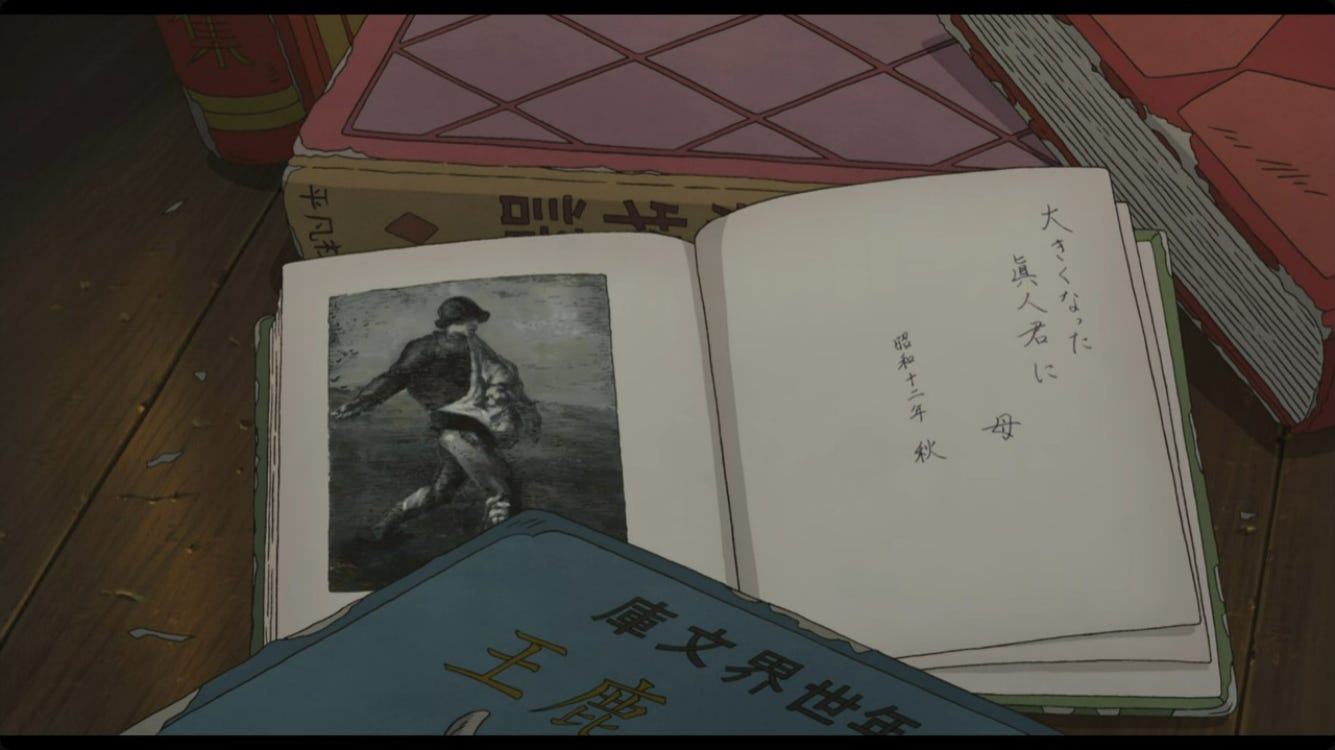
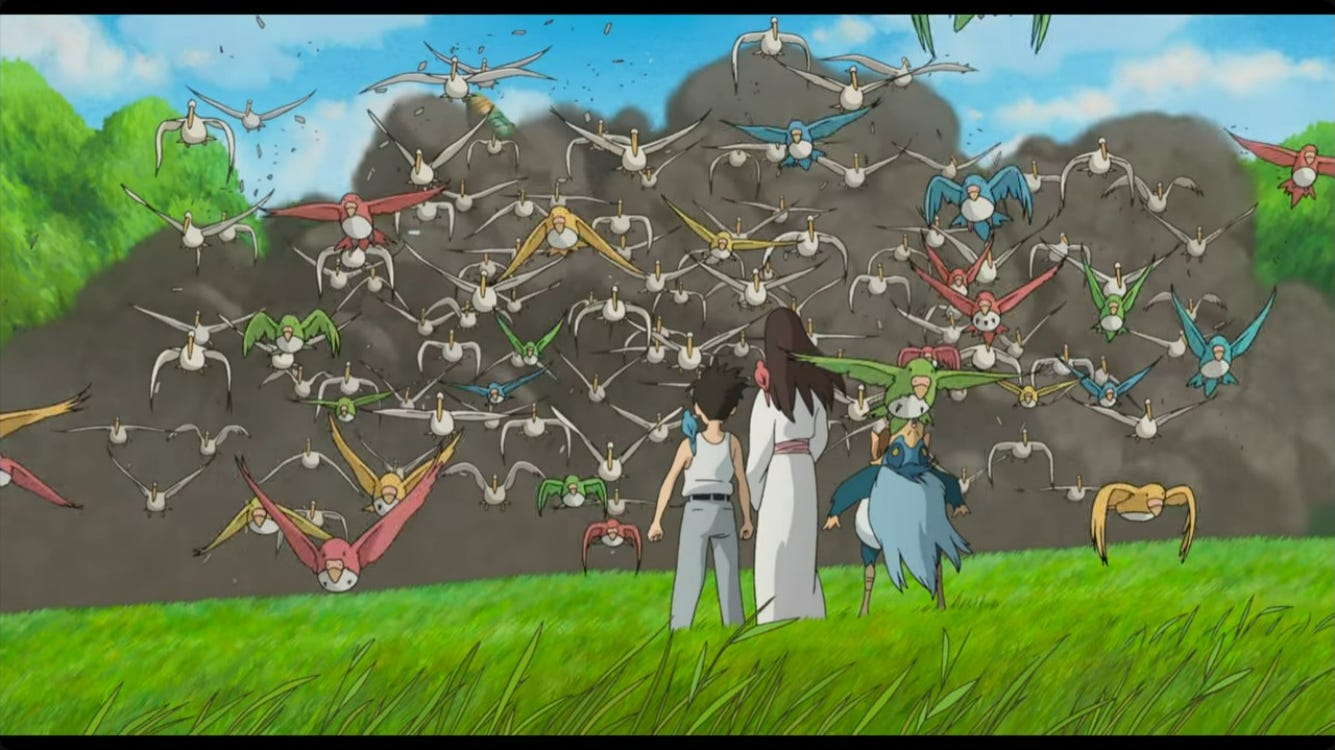
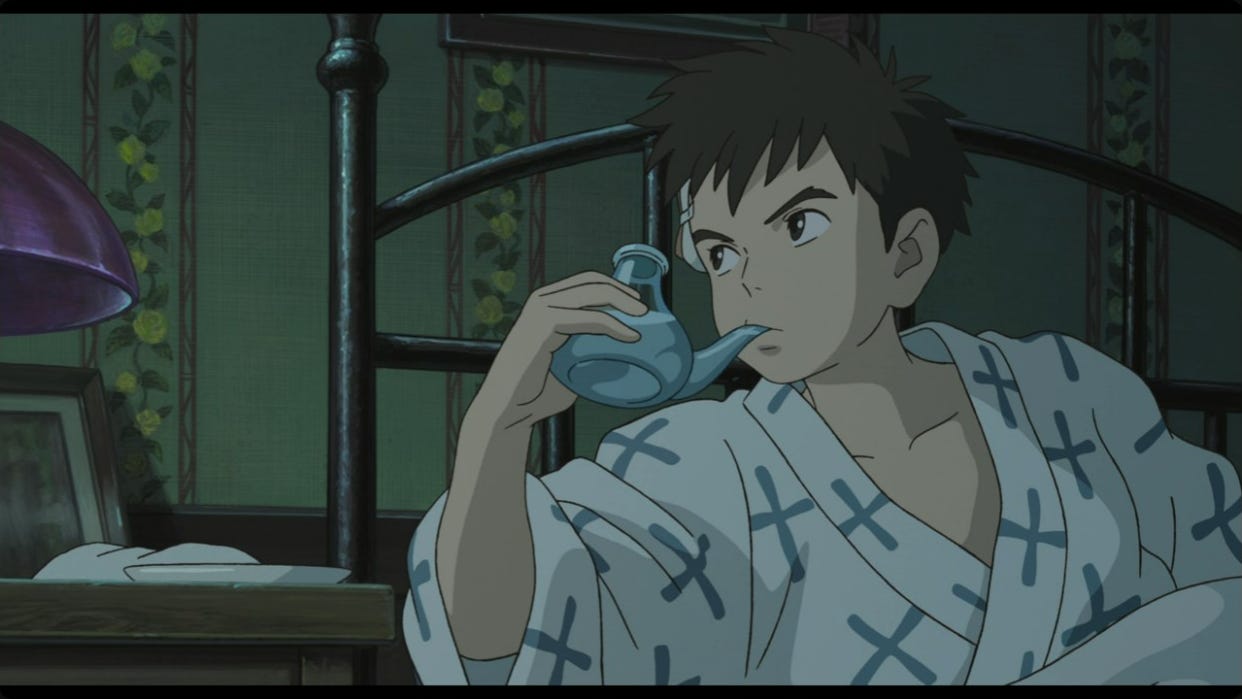
More like The Lion, the Witch, and the Wardrobe than Yoshino’s novel, Miyazaki’s film is a fantasy set in a staggering mage’s tower where dream logic reigns: anthropomorphic birds rule an authoritarian state, and marshmallow souls float above an expansive sea, waiting to be reborn. At the center of it, a dying wizard is trying to keep the tower standing even as he knows he is dying. About a third of the way through the film, before Mahito descends fully into the fantasy, he is exploring his new room in the countryside. He finds a copy of Yoshino’s novel. He opens it and discovers that his mother has left an inscription for him, written in anticipation of when he would be old enough to read it. And as he reads, he begins to weep.

For an audience unfamiliar with Yoshino’s How Do You Live?, this scene can feel like a non sequitur. A boy finds an old book, reads it, and cries. The film does not explain itself, and it would take something away if it did.

If you know the novel, however, if you know what Copper’s story contains, the scene opens entirely. Copper is a boy navigating life after the loss of his father, guided by an uncle who offers him a framework for the bewildering scale of the world. Mahito is a boy navigating life after the loss of his mother, with no such guide. Like Copper, Mahito faces bullying and alienation by his peers. When Mahito reads Yoshino’s novel, he finds a mirror. The novel reflects back to him a grief he recognizes as his own, held by another consciousness, which tells him that he too is part of the net of human particles. He is connected to everyone who has ever lost someone, not singular in his suffering but joined to it. And when he surfaces from the reading, he has been somewhere he could not have gone any other way. It is meaningful that the descent into the fantasy world only begins after this scene at the forty minute mark, almost a third of the way through the film.

What is remarkable is the metatextual structure Miyazaki has built. The film that brought me to Yoshino’s novel depicts a boy being brought to Yoshino’s novel. My experience of discovering the book through the film precisely mirrors the scene the film contains. I was watching what had happened to me. The novel was working on me in the same way it worked on Mahito.

Yoshino’s title is a question, not a description. This is why the renaming of Miyazaki’s film for Western audiences seems to me a more consequential decision than it first appears. The Boy and the Heron describes what happens. How Do You Live? asks something of the person watching. There is a version of fiction that hands you a story and seals it shut, and there is a version that leaves the question open and puts it back in your hands. The second kind is harder to make and harder to receive. It is also the only kind, I think, that is genuinely worth having in a time like this: not because it prepares you or lets you escape, but because it asks you to stay present inside an impossible question and keep working.

* * *

The novel closes on a spring morning. Copper wakes before dawn in a room full of mist and listens to a nightingale singing from somewhere invisible in the distance. He sits at his desk with a new notebook and begins to write to his uncle.

Having been restored to his friends, Copper writes about his father’s last wish, that he should be a great example of a human being, and about his own smallness in relation to it. Although he is not yet able to produce anything, he can become a good person, he writes, and if he can do that, he might become a person who can create even more than that.

Then he pauses and looks out the window at the city, imagining his friends: Uragawa already working at his steaming pot of tofu, Kitami’s sleeping face. The joy of having good friends comes flooding back into his chest. And he writes:

>

It is not accidental that Yoshino sets this final chapter on a spring morning still wrapped in mist. The novel’s penultimate chapter discussing Greek Buddhas falls during Higan, the seven day spring equinox celebration. Higan means the far shore, the other side of the river of suffering. Yoshino places Copper’s resolution exactly at that pivot between darkness and light. We call the same pivot Easter. It is not the easy Easter of managed sentiment, but the Easter that holds both sides together: the snowballs dropped and the charcoal fire; the bitter weeping and the patient question asked again. The risen Jesus on the beach is not a different Jesus than the one who was abandoned. He is the same Jesus, bearing the same wounds, asking the same question three times because once was not enough.

Copper’s hope is not naive. He has just written from a place of moral reckoning, having confessed his cowardice and having lived through the Gandhara chapter with its double knowledge that civilizations build beauty and wage war with the same hands. He knows the net is tangled even as he writes: “I think there has to come a time.”

In the English translation, the word “has” is doing something important. Rather than being the language of prediction or optimism, it is the language of an ethical imperative working itself into a form of hope. The world has to become that place because the alternative, that it cannot, that the net will only ever be an engine of harm, is not a conclusion Copper is willing to inhabit.

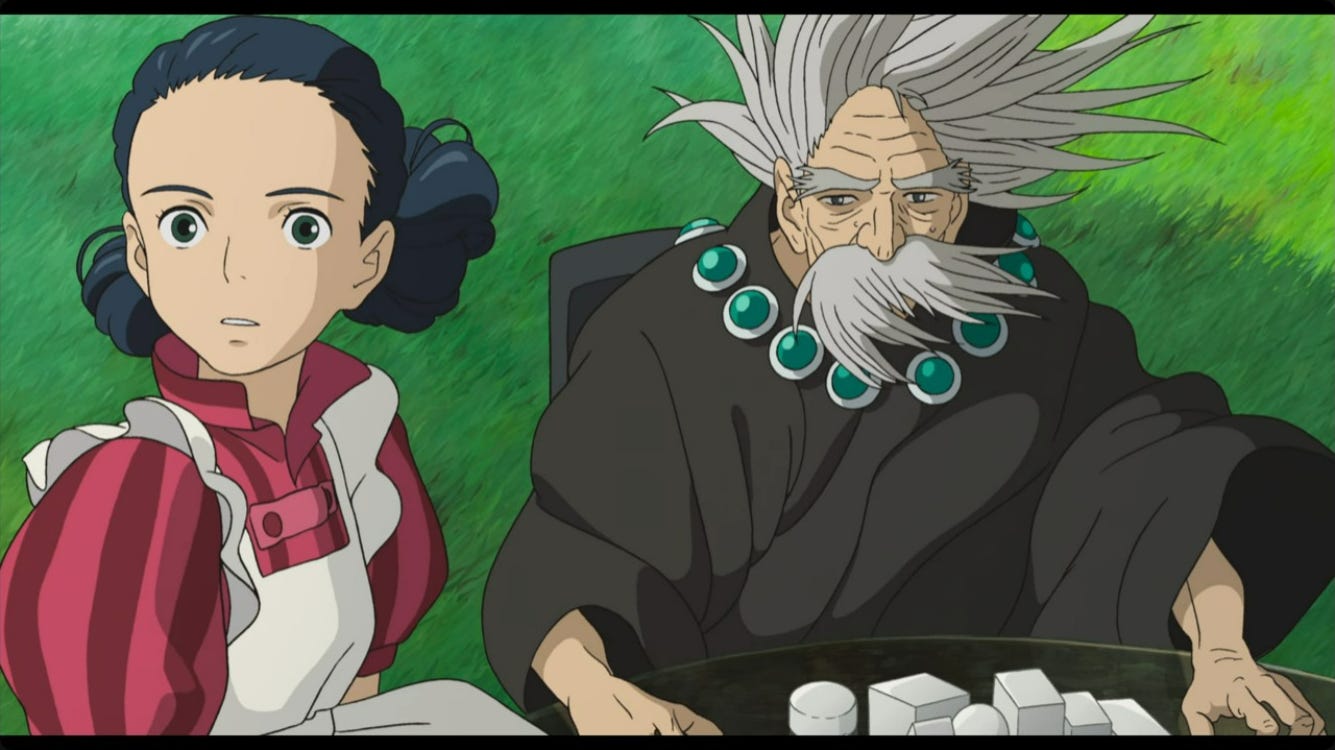
Towards the end of The Boy and the Heron, Mahito ascends further into the fantasy world, to the tower, where his granduncle wizard leans over a stack of stone blocks. The blocks seem to breathe with their own energy, representing the fragile order of the fantasy world created around them. The wizard’s hands hover above them with a kind of desperate patience. He tells Mahito that the power of their bloodline runs through him alone now, and asks him to take up the burden of rebuilding the fantasy world. Then, this wizard offers a new set of clean, unblemished blocks. Mahito studies them as he touches the thin scar across his temple. He understands that the world’s malice is not separate from his own, but that he is not bound by his failure. When he refuses the wizard’s charge, he states that he needs to return instead to his family in the real world, a new family he can accept for the first time.

>

Mahito likens his family to the people he met in the fantasy world, he can see them as they truly are and call out to them for the first time because of the experience of this fantasy. Yet, he has to let it go. The granduncle accepts Mahito’s decision, and the tower shortly afterwards begins to collapse around them.

I look at my students in Beirut and see all they have gone through: the port explosion, economic collapse, ongoing conflict. There are evacuation orders and the sound of jets overhead. They play football. They laugh. They read or watch or listen to stories. Can a story, even a hard story, help a child going through war? Stories do not make you safe, but they expand what it is possible to be. They make the invisible net of our lives shimmer with morning dew.

On Easter morning, the stone is rolled away and the tomb is empty, and the question that meets the women at the entrance is the same question Mahito’s granduncle asks him and the one Yoshino’s narrator finally asks the reader: How will you live? In the full weight of what you know, in the city that is being bombed, beside the charcoal fire, in the mist that is already lifting. How will you live?

I think there has to come a time.

Postnote: There are a few ideas I found intriguing but could not fully explore in this article. The wizard, Mahito’s granduncle, mentions that he only has to stack the stones every three days, a detail that subtly echoes the three-day resurrection in Christianity. A major theme of the film, and in some ways the novel, is accepting the loss of a loved one and learning to live with grief. This is exemplified in a scene towards the end of The Boy and the Heron, when Mahito must say goodbye to Himi, a past, younger version of his mother, so that she can return to her world and prepare to have him as a son. On the other hand, I wished I could have attended to the ways that this story offers American audiences a rare opportunity to see World War II from the Japanese, which is to say “the enemy’s”, point of view. Much like Grave of the Fireflies*, these kind of stories humanize conflict, revealing the devastation and loss on both sides. Likewise, Yoshino’s novel is deeply humanistic and largely disinterested in religion, or perhaps regards it as a force potentially as destructive as militaristic nationalism, an idea hinted at in Copper’s uncle’s explanation of the persecution of Galileo Galilei. Nevertheless, I wanted to reflect on the fact that its themes feel universal, resonating across Christian and Buddhist traditions. Finally, I wish I could have expanded on a particular reading of* The Boy and the Heron which explicates the history of Studio Ghibli itself, particularly the complex relationship between Isao Takahata (whose film Only Yesterday remains a personal favorite of mine) and Hayao Miyazaki, though exploring that connection fully did not fit the focus of this discussion.

Works Cited

How Do You Live? by Genzaburō Yoshino, translated by Bruno Navasky. Algonquin Books, 2021.

The Boy and the Heron. Directed by Hayao Miyazaki, Studio Ghibli, 2023.

Two years after the war, we returned to Tokyo.

— Mahito, The Boy and the HeronHow Do You Live? in a Time of War

u/_fumeofsighs — 8 hours ago

General approach to what films you watch

There's a lot of talk about specific films, artists etc. but what about the overall approach to cinema? There are thousands of films so how do you make your picks and what's your advice for others? We all follow our own unique path in experiencing art but I think that sharing our approaches can be useful to others.

Personally, I work on two "directions". The first and easier one, is to watch the best new films. Depending on free time, how much you enjoy them, whether it's a good film year etc. this can be 30 films or 100 per year but I think that's a good range. I prioritise new films firstly because I think the mastery on most technical aspects (like visual effects, sound) is at its peak now compared to the past and secondly, because the best time to experience a film is the closest to its release. The creators are humans living like everyone else so they are influenced by the present, watching their creations as soon as possible is ideal. I pick the best films of the year by various criteria like imdb ratings, googling best films of the year lists, awards, artists I trust etc.

The second direction is older films and it's more complex. I started as a kid by watching films on TV which usually meant going back max 30 years, in genres I enjoyed the most like actions films. When internet bandwidth increased, I found the imdb top 250 film list. Then I found the theyshootpictures 1000 greatest films list that I went though. Now I make mini projects of my own, like the silent era, I made a list of the best silent films and watched them chronologically. Other projects have been music films or specific arists like Renoir and Mads Mikkelsen.

My approach for past films started kind of random then more structured and that's what I would advise. Start by watching past films from recent decades/directors/genres you most enjoy so as to build a strong base. When you feel ready for it, go even further in the past, explore directors that are famous but you don't know so much, genres that aren't your favourites but not your worst either. Finally, go for very old films up to eventually the silent era, directors recognised for their artistry but also difficulty (like Angelopoulos), genres that you dislike.

Random tips:

  • I try giving all films my full attention, putting the mobile phone away is ideal.
  • Never consume trailers or any material regarding a film you might watch. The less you know, the better. Even the film's duration and actors can be spoilers in a sense. It requires a lot of self-discipline but there are so many positive surprises this way.
  • I rarely ever watch films a second time. That's not because I remember them perfectly or that I find no value in rewatching films. It's just that I want to experience as many new films as possible. When I get older however, I plan to rewatch the ones I enjoyed the most.
  • The more self-imposed restrictions you get rid of, the better. Genres and artists you dislike, taboo or triggering subjects etc.
  • Don't get discouraged when you find yourself in a phase where you don't want to watch films! The desire will probably come back after a while, especially if you mix up things with reading books, listening to music, playing games etc.
  • Once fully committed to a subject, chronological order, whilst monotonous, is more rewarding.
  • Be your own curator, avoid the algorithms.
reddit.com
u/Eladir — 23 hours ago

Final girl trope

SPOILERS

ok so this is something I wanted to talk about in horror and slasher movies recently coming out....I saw the web series Something Very Bad is going to happen and I honestly did not like the ending because the girl actually got the ending she wanted of not marrying....it's not just this...slasher films like Scream 7 Halloween and TCM...all these movies and shows somehow portray a badass final girl who usually gets her friends killed and all...it's just very repeated....I am tired of seeing femme fatales always surviving which obviously they deserve in the show but I feel like the cast should be diversified and given equal opportunities at least somewhere....I feel it's just so repeated....bad decisions are often made by such characters and I feel they get everything they want....because if I talk specifically of the show itself I feel like the girl carried the curse...she was obviously marrying for the sake of survival and finally got to be in the same page as the groom at the end and yes the groom f\*cked up right at the end which had devastating consequences....I feel like all the development of loving she got instantly disappeared and she reverted back to her original personality which kinda takes from the show for me....all this just to give her this badass ending which honestly is also the case with almost all slashers nowadays....I feel that everything happening to the others because of the final girl in the movies and shows is caused by her and they get off with less repercussions and more of that cold detached personalities you see people like Sidney Prescott get....no genuine person who just cares and is a good moral support and heart of the group ever gets an happy ending because of a single mistake....I am not good with words but I hope I made sense in what I am trying to say here and hopefully people notice that there's a pattern....I want cast in movies to be developed and given equal importance and hopefully get developed as the time progresses....I hope I made sense

reddit.com
u/purifyyyyy — 6 hours ago

Comic book movies and emotional age

So I'm sort of a film buff. I never really think of myself as one. I think of all my other hobbies, vocations, and compulsions first. I'm a writer, comic, circus performer and bettor, gambler, alcoholic, addict and mentally ill before a film butf. I'm rarely watching movies because I rarely watch nonfiction movies, instead watching more documentaries and news/comedy podcasts but I'd say I like a really good movie that will make you think and feel. I like serious drama films by Lars Von Trier, comedies by Noah Baumbach and Greta Gerwig, and screwball comedy by Taika Waititi. The last great movies I saw were Shame, If I Had Legs I'd Kick You, Palm Trees And Power Lines and Margaret. I would classify all these as art.


That said I like a good X-Men or Avengers movie just like everyone else but they don't raise to the same level. I really like Black Widow because Scarlett Johansson can shine.


In an interview Martin Scorcese shrugged off Marvel movies as not being art. I thought of this in the middle of watching Dark Phoenix which was universally oanned and is a clunky, simplistic and melodramatic tale of Jean Gray. I got to thinking that it may not be possible to do an ensemble movie with the emotional depth necessary for the subject matter involved. Either we get the deeply personal tortured past of Jean or we get served up the good times we're used to from X-Men or The Avengers. The standout prequels with psychokogical and emotional depth that are far and away better than all of the others are Logan and Joker. In the end though I feel like those movies are more simplistic than often is noticed. Logan is the tortured hero who saves the children and Joker is the tortured villain made evil by society. These are simplistic narratives from serialized kids' books of course. When I see The Dark Knight I don't see an award winning performance from Heath Ledger. I see a bunch of stigmatizing bullshit. At least Joaquin Phoenix can dance like a madman and really sell the character.


I may be a pretentious, underachieving fuckwit who knows a lot about movies for someone who claims he doesn't watch many, but at least I believe in humanity and am not a misanthtopic thousand-yard-stare havin filmmaker like Todd Solandz. I wrote a bunch of dark depraved fiction too and had the balls to call it comedy. I'm glad I'm not the same person I was in my 20s. I think it's interesting to view film through the lens of emotional age. I'm damn sure the childish among us have more fun saving the world.

reddit.com
u/StoopSign — 5 hours ago
Week