
How Do You Live? in a Time of War: a discussion of The Boy and the Heron (2023) and its source
Note: this is an essay I published elsewhere. I am reproducing it here without a link, so as to avoid the semblance of self promotion. If you are interested in my other writing, you can just search this text.
Warning: This article discusses major plot developments in Genzaburō Yoshino’s How Do You Live? and The Boy and the Heron by Studio Ghibli. Significant spoilers follow.
“I know it’s a lie, but I have to see.”
— Mahito, The Boy and the Heron
The scene begins with blaring sirens cutting through the night air. Their rising pitch crosses the clang of a distant alarm. A boy gets out of bed and hastily changes from a kimono and wooden sandals to more practical clothes. Smoke drifts along the street in shifting layers, carrying the heat of a blaze already out of control. Through the haze, flames climb up the facade of a hospital. Windows burst outward as embers scatter into the wind. At the edge of the crowd, the boy sprints forward until hands pull him short. He stands before the inferno, held in its light, unable to move closer or withdraw.
The fire dims into memory as the image darkens. Into the stillness, a voice enters: “Three years into the war, Mother died. And a year later, my father and I left Tokyo.”
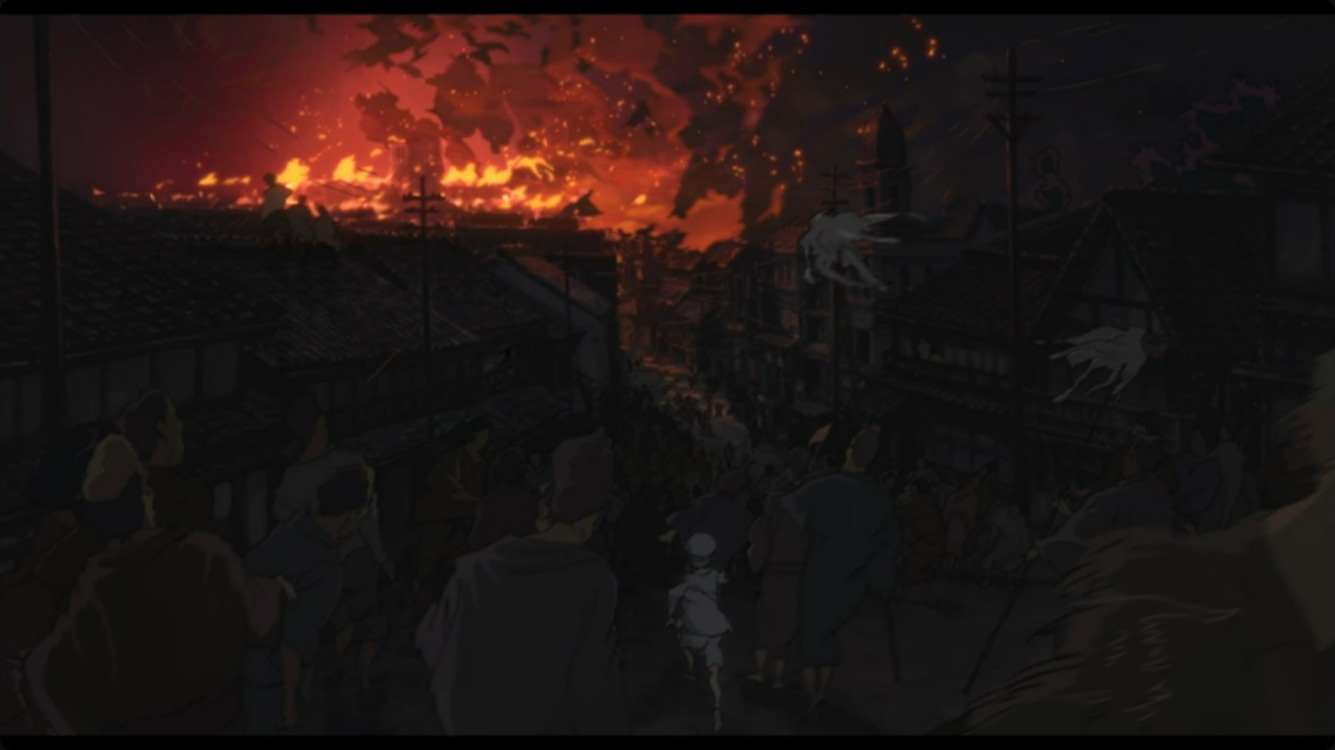
Hayao Miyazaki’s final film, The Boy and the Heron, was originally released in Japan under the title Kimitachi wa Dō Ikiru ka, which translates as How Do You Live? The title comes first from Genzaburō Yoshino’s 1937 novel, which Miyazaki says he wept reading as a boy and which Miyazaki alludes to in the course of his film. The novel follows a junior high student in Tokyo named Junichi “Copper” Honda, who moves through the ordinary crises of adolescent life. After the death of his father, the boy is guided by his uncle’s letters, which ask him, again and again, to consider what it means to act with integrity in a world held together by mutual dependency.
I came to Yoshino’s novel through the film. I came to both again in Lebanon, in the spring of 2026, living and teaching in a city that was and is being bombed. It is Holy Week as I write this, and the question the novel puts to its reader—“How will you live?”—feels less like a literary provocation and more like the kind of question that only makes sense when everything around you is uncertain. This essay is my attempt to think through what happened when I read it here.
* * *
Lebanon’s safety collapsed fast in the spring of 2026 after the United States and Israel began their war with Iran. Hezbollah dragged Lebanon into the conflict, and Israeli strikes began in the south of the country and in Beirut’s southern suburbs. Within days, the strikes had reached more and more neighborhoods where thousands of families displaced from the south had taken shelter, believing the worst was behind them. Schools became sleeping quarters and the crisis worsened. Most of Lebanon’s youth, including my students, have grown up through economic collapse, experienced the aftermath of the 2020 port explosion, and are now accumulating a second or third layer of memory defined by evacuation orders and the sound of jets overhead.
After a week of hostilities, I found myself reaching for some story I could liken my experience to. The first one that came to mind was The Lion, the Witch and the Wardrobe. What is easy to forget is that Lewis’s novel is framed by a wartime evacuation: the four Pevensie children have been sent from London to the countryside to escape the Blitz. Displaced and living in a strange house, it is from within that specific condition that they are able to escape into a fantasy world. Critics of fantasy tend to call it escapism, and I want to take that seriously before I reject it. In a shelter I visit down from my school, the children of displaced migrants play phone games and kick footballs in the courtyard. They play with each other. They laugh and have fun. That is an escape in its purest form, a brief and necessary interruption of fear. I would not take it from them.
But I do not think escapism is what fiction does best. I have come to think that stories ought to work less like an escape room and more like a flight simulator. In an escape room you seal yourself off: the locks turn, the outside world ceases to exist, you are briefly elsewhere. A flight simulator does the opposite. When a pilot climbs into one, she is not pretending that gravity does not exist. She is voluntarily entering a space where the crisis is real enough to train on, precisely so that when she encounters it in the actual cockpit, she does not freeze. Where that analogy cracks is that I am standing in a classroom outside Beirut working out what fiction does for children in wartime, and the planes I am using as a metaphor are the same planes I can hear overhead.
What I keep arriving at is this: the most important thing fiction does is give us the chance to live lives that are not our own. Not metaphorically, but in some genuine and irreducible sense, to inhabit another consciousness and feel the weight of another person’s choices. The Pevensie children, rather than just surviving Narnia, become people who have been kings and queens. They have carried grief and responsibility in a world other than this one, and they bring all of that back when the wardrobe closes. That expansion is not preparation for anything in particular. It is an enlargement of what it is possible to be.
In Yoshino’s novel, the uncle makes a distinction that is worth returning to. There are things that can be taught, he tells Copper, and there are things that cannot be taught. Chemistry, grammar, and algebra can be explained in words and transferred from one mind to another. But the taste of cold water can only be understood by drinking it. The color red can only be known by someone who has seen it.
>
Fiction is one of the few mechanisms we have for manufacturing that kind of encounter with lives we will never directly live.
* * *
The publication of How Do You Live? is itself a minor act of courage: Yoshino wrote it as the final entry in a series intended to bring progressive ideas to young Japanese readers at precisely the moment when such ideas were being suppressed by the rise of Japanese militarism (185). He hid his philosophy in the plainest possible sight. One winter, at the climax of the novel, Copper and his friends swear that if they are attacked, they will stand together. They say it as schoolboys do, meaning it completely, because they have not yet been tested, and the test comes quickly.
A group of older judo club students surrounds Copper’s friend Kitami in the schoolyard and demands that he submit to them. Kitami refuses. His stubbornness is a personality trait, but in the logic of 1930s Japan it is also a form of moral witness against the conformity the state is demanding of its citizens. When the older boys move to enforce compliance, Copper is watching from the edge of the yard. He had been ready with snowballs behind his back. When the moment comes, however, he quietly drops them and watches Kitami get beaten along with the others who try to help. When it is over, Copper stands alone a few meters from his friends as they cry and console each other. Yet he can neither lift his head nor bring himself to call out. As the sun throws bright light down from above the school building, Yoshino writes, nothing could have been lonelier than Copper’s figure, casting its long shadow across the yard.
Copper goes home with a fever. In his delirium, he replays the moment over and over: Coward. Coward. Coward. He cannot stand the thought of returning to school and facing his friends. He also cannot stand the thought of never seeing them again. He is caught between two unbearable things.
I read this scene in Beirut during Holy Week, and it stopped me completely. Not because I was drawing a theoretical parallel, but because Copper’s paralysis in that schoolyard is one of the oldest stories in the world. It is Saint Peter’s story. Peter, who swore he would never deny his friend and teacher, meaning it completely, because he had not yet been tested. Peter, who warmed himself by a night fire while the trial went on inside and said, three times, I do not know him. Peter, who went out afterward and wept bitterly. Copper buries his face in his nightclothes so his mother will not hear. The posture of grief after betrayal is strikingly consistent across centuries. And in both cases, the story does not end there.
The uncle’s response does not let Copper off easily. He tells the boy that he did in fact err. Yet, it would likewise be a mistake to apologize only if he thought it would restore his friendship. He explains that the first thing Copper must do is apologize to Kitami “like a man.” That is to say honestly and without making excuses. What happened after that is not for him to worry about.
Copper writes the letter to Kitami. He does not know if he will be forgiven, but he sends it anyway. Perhaps this is the unique human pain that Copper’s uncle writes about, a pain that comes from knowing you were wrong, a pain that also makes us human.
>
Rather than appear to Peter with a theological argument, the risen Jesus makes a charcoal fire on the beach and cooks fish, and over that fire, the same kind of fire at which Peter had denied him, asks three times: Do you love me? Three times the question, three times the answer, three times the restoration. In this, Jesus is showing a willingness to sit with the person who failed and ask him to consider these actions again and again. Copper’s uncle does the same.
In the end, Copper recovers from his illness and anxiously awaits a response from Kitami to the apology letter he sent. Days pass without word, and on the fourth day, Kitami, Mizutani, and Uragawa arrive at Copper’s home. They quickly reassure him that the letter resolved any lingering tension, and the friends reconnect naturally, their earlier conflict forgotten.
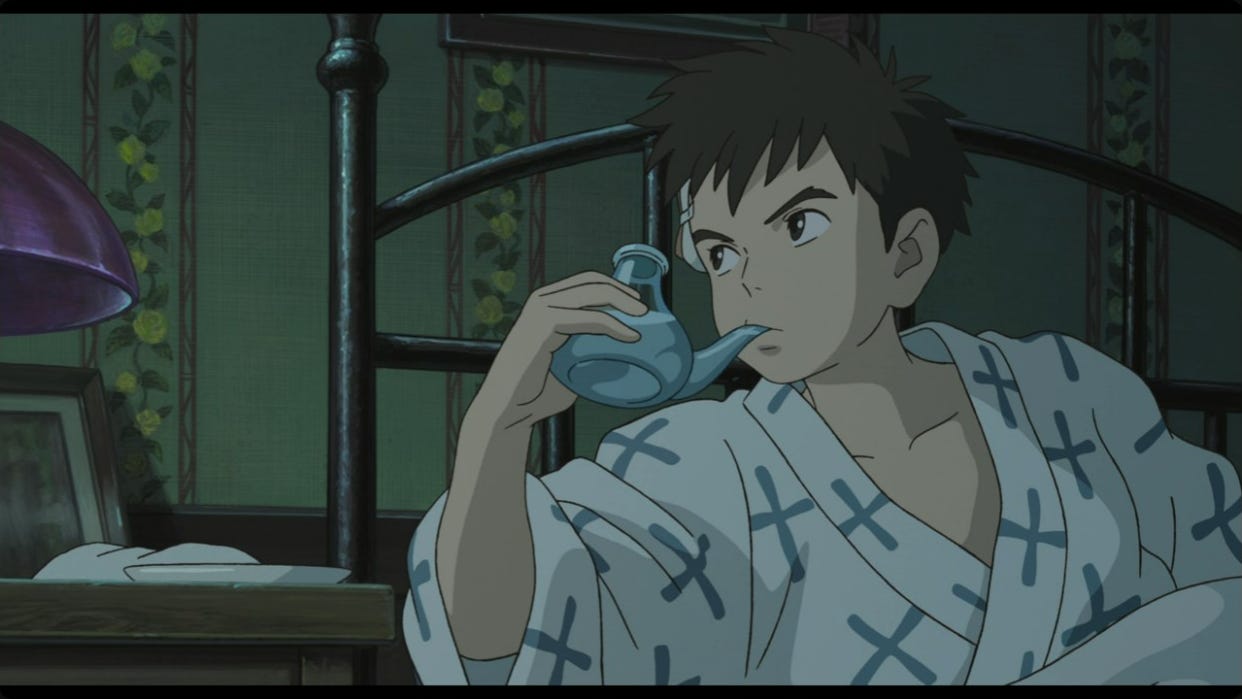
* * *
Earlier in the novel, Copper comes to a grand realization when he is standing on the roof of a department store and looking down at the city spread below him. The sea of umbrellas below comes to seem like an ocean, the buildings like crags jutting up from its surface. He shivers, seeing the landscape as densely packed, with small roofs crowded together like sardines, each one sheltering its own cluster of human lives. (15) This moment results in the Copernican shift from which Copper gets his nickname. As a person, he is able to understand, not intellectually but in his body, that he is not the center of the world, the same way the sun does not revolve around the Earth. There are other ways to see the world. As Copper reflects on this realization, he develops his own theory of the human particle. People are like water molecules, apparently separate but bound to one another through invisible currents of activity. He traces the origin of a single glass of powdered milk, following it from Australian farms through the workers who processed and shipped it, and the realization opens out until he cannot stop it:
>
Everything is related and mutually dependent. The uncle steers Copper away from the nihilism this vision could produce. Interconnectedness does not diminish individual worth; it clarifies our duty to each other. Every movement a person makes pulls on a string that inevitably affects another.
Later in the novel, during the Buddhist festival of Higan, Copper and his uncle fall into a conversation about Buddhist sculpture. The uncle shows Copper photographs of the Gandhara Buddhas, the oldest known representations of the Buddha in human form, excavated from the region around Peshawar in what is now Pakistan. Their faces, Copper notices at once, are not Indian. They look Western, and the fabric of their robes folds exactly as Greek stone folds.
The uncle confirms it: the first people to carve the Buddha’s form were Greeks. Greek sculptors living in the East, soaked in the atmosphere of Buddhism, produced something that belonged to neither tradition alone: a face with Apollo’s proportions informed by the Buddha’s teaching. The reason so many Greeks were living in northwest India traces back to Alexander the Great, who in 334 BC crossed the Hellespont and spent more than a decade subjugating Asia, all the way to the Indus River. His ideal, the uncle says, was to establish one great empire out of the East and West together, blending civilization into civilization. A perhaps noble ideal carried out by the sword, what his ideal made possible, across many generations, was the Gandhara Buddha. Those Buddhas traveled across the Himalayas and the Hindu Kush, through China and Korea, until they arrived in Japan sixteen hundred years ago. The great Buddha at Nara, if you follow its artistic lineage back through China, through India, through Gandhara, arrives finally at a Greek sculptor in northwest India, who was there because of Alexander’s dream of unity. “Art and knowledge know no borders,” Copper’s uncle writes (179).
Alexander’s campaign led to the beauty of artistic accomplishment, but it was also brought about by conquest. There was displacement. Soldiers died in foreign lands to which they did not choose to travel. The net Copper discovers through his glass of powdered milk was woven, thread by thread, through every catastrophe as much as every mutually beneficial market and cultural exchange. And the Israeli strikes on Beirut that I can hear overhead are pulling on strings whose origins I cannot yet fully trace.
* * *
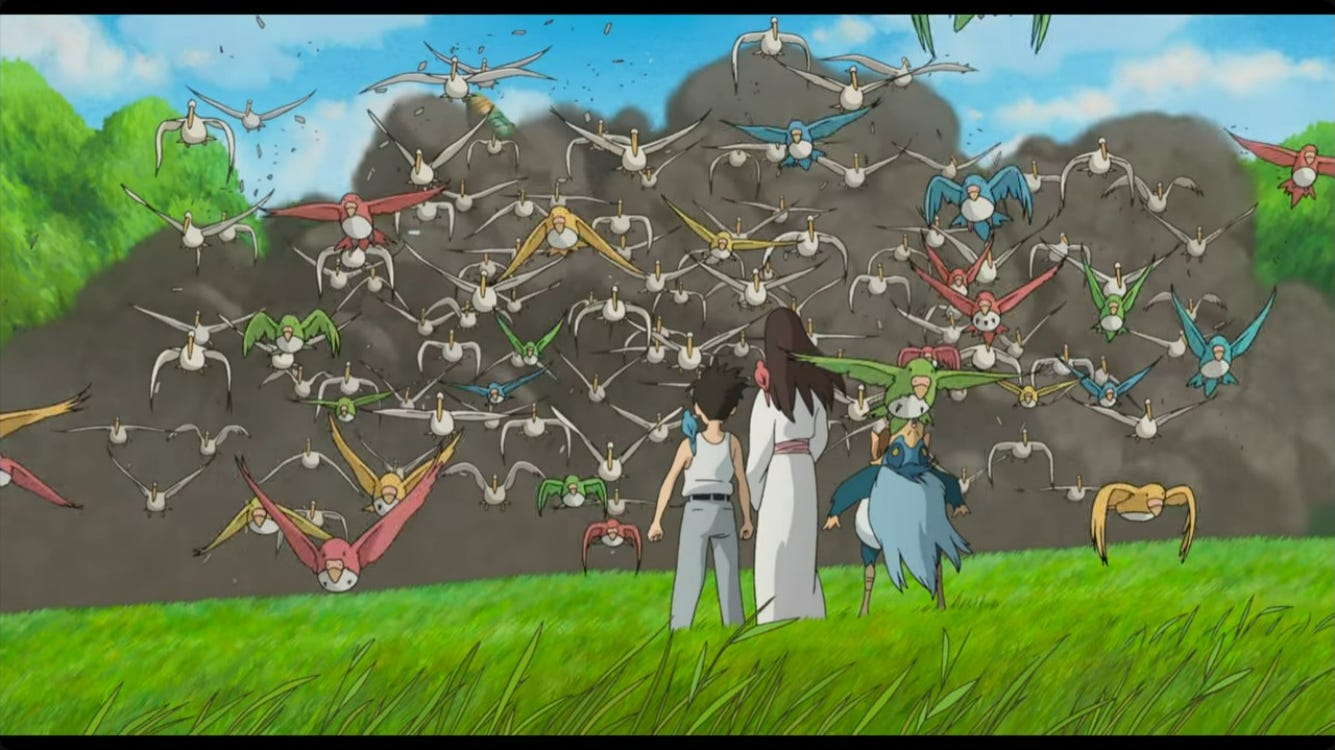
More like The Lion, the Witch, and the Wardrobe than Yoshino’s novel, Miyazaki’s film is a fantasy set in a staggering mage’s tower where dream logic reigns: anthropomorphic birds rule an authoritarian state, and marshmallow souls float above an expansive sea, waiting to be reborn. At the center of it, a dying wizard is trying to keep the tower standing even as he knows he is dying. About a third of the way through the film, before Mahito descends fully into the fantasy, he is exploring his new room in the countryside. He finds a copy of Yoshino’s novel. He opens it and discovers that his mother has left an inscription for him, written in anticipation of when he would be old enough to read it. And as he reads, he begins to weep.
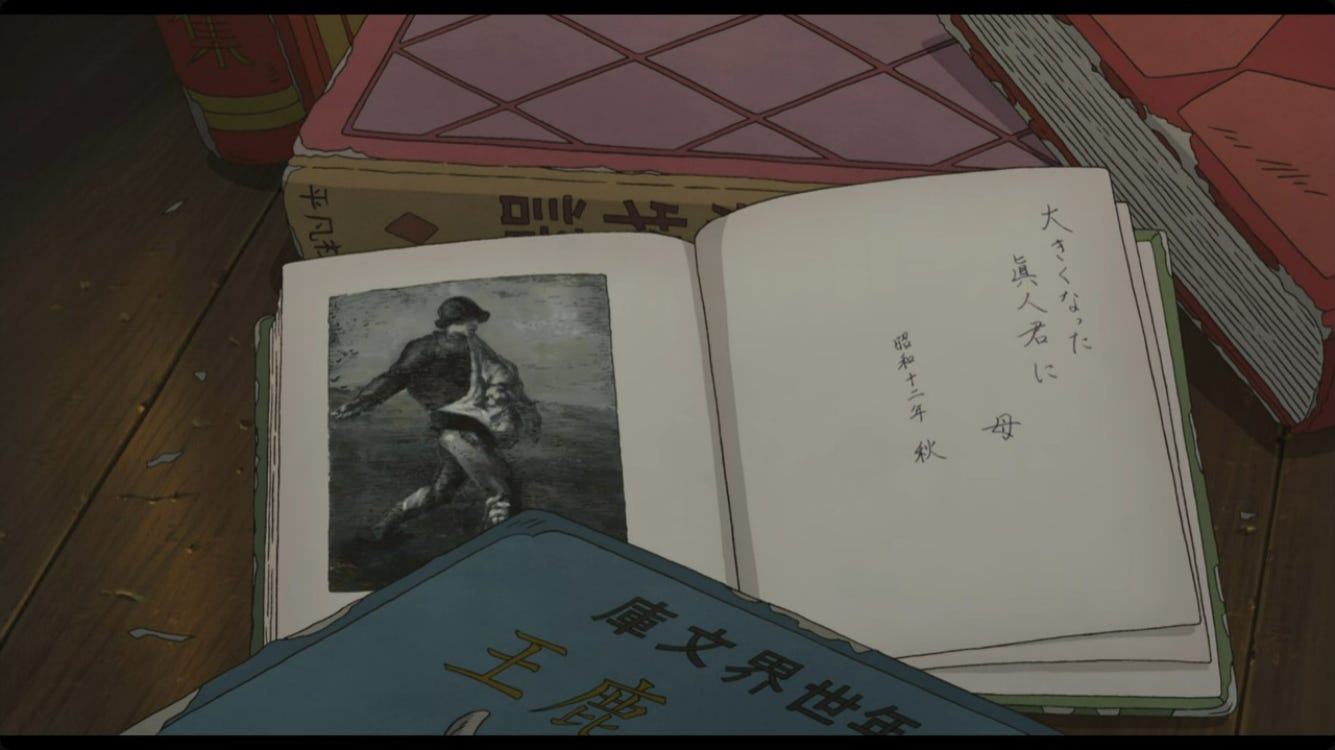
For an audience unfamiliar with Yoshino’s How Do You Live?, this scene can feel like a non sequitur. A boy finds an old book, reads it, and cries. The film does not explain itself, and it would take something away if it did.
If you know the novel, however, if you know what Copper’s story contains, the scene opens entirely. Copper is a boy navigating life after the loss of his father, guided by an uncle who offers him a framework for the bewildering scale of the world. Mahito is a boy navigating life after the loss of his mother, with no such guide. Like Copper, Mahito faces bullying and alienation by his peers. When Mahito reads Yoshino’s novel, he finds a mirror. The novel reflects back to him a grief he recognizes as his own, held by another consciousness, which tells him that he too is part of the net of human particles. He is connected to everyone who has ever lost someone, not singular in his suffering but joined to it. And when he surfaces from the reading, he has been somewhere he could not have gone any other way. It is meaningful that the descent into the fantasy world only begins after this scene at the forty minute mark, almost a third of the way through the film.
What is remarkable is the metatextual structure Miyazaki has built. The film that brought me to Yoshino’s novel depicts a boy being brought to Yoshino’s novel. My experience of discovering the book through the film precisely mirrors the scene the film contains. I was watching what had happened to me. The novel was working on me in the same way it worked on Mahito.
Yoshino’s title is a question, not a description. This is why the renaming of Miyazaki’s film for Western audiences seems to me a more consequential decision than it first appears. The Boy and the Heron describes what happens. How Do You Live? asks something of the person watching. There is a version of fiction that hands you a story and seals it shut, and there is a version that leaves the question open and puts it back in your hands. The second kind is harder to make and harder to receive. It is also the only kind, I think, that is genuinely worth having in a time like this: not because it prepares you or lets you escape, but because it asks you to stay present inside an impossible question and keep working.
* * *
The novel closes on a spring morning. Copper wakes before dawn in a room full of mist and listens to a nightingale singing from somewhere invisible in the distance. He sits at his desk with a new notebook and begins to write to his uncle.
Having been restored to his friends, Copper writes about his father’s last wish, that he should be a great example of a human being, and about his own smallness in relation to it. Although he is not yet able to produce anything, he can become a good person, he writes, and if he can do that, he might become a person who can create even more than that.
Then he pauses and looks out the window at the city, imagining his friends: Uragawa already working at his steaming pot of tofu, Kitami’s sleeping face. The joy of having good friends comes flooding back into his chest. And he writes:
>
It is not accidental that Yoshino sets this final chapter on a spring morning still wrapped in mist. The novel’s penultimate chapter discussing Greek Buddhas falls during Higan, the seven day spring equinox celebration. Higan means the far shore, the other side of the river of suffering. Yoshino places Copper’s resolution exactly at that pivot between darkness and light. We call the same pivot Easter. It is not the easy Easter of managed sentiment, but the Easter that holds both sides together: the snowballs dropped and the charcoal fire; the bitter weeping and the patient question asked again. The risen Jesus on the beach is not a different Jesus than the one who was abandoned. He is the same Jesus, bearing the same wounds, asking the same question three times because once was not enough.
Copper’s hope is not naive. He has just written from a place of moral reckoning, having confessed his cowardice and having lived through the Gandhara chapter with its double knowledge that civilizations build beauty and wage war with the same hands. He knows the net is tangled even as he writes: “I think there has to come a time.”
In the English translation, the word “has” is doing something important. Rather than being the language of prediction or optimism, it is the language of an ethical imperative working itself into a form of hope. The world has to become that place because the alternative, that it cannot, that the net will only ever be an engine of harm, is not a conclusion Copper is willing to inhabit.
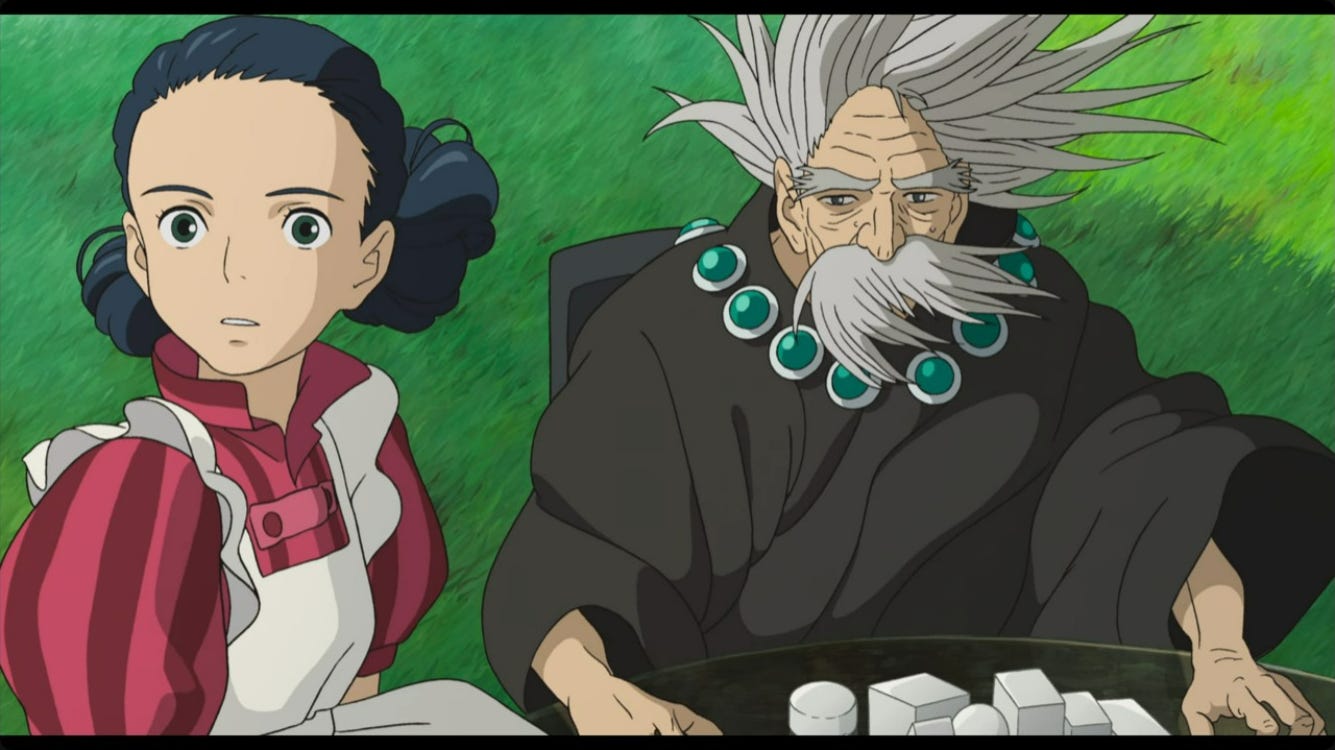
Towards the end of The Boy and the Heron, Mahito ascends further into the fantasy world, to the tower, where his granduncle wizard leans over a stack of stone blocks. The blocks seem to breathe with their own energy, representing the fragile order of the fantasy world created around them. The wizard’s hands hover above them with a kind of desperate patience. He tells Mahito that the power of their bloodline runs through him alone now, and asks him to take up the burden of rebuilding the fantasy world. Then, this wizard offers a new set of clean, unblemished blocks. Mahito studies them as he touches the thin scar across his temple. He understands that the world’s malice is not separate from his own, but that he is not bound by his failure. When he refuses the wizard’s charge, he states that he needs to return instead to his family in the real world, a new family he can accept for the first time.
>
Mahito likens his family to the people he met in the fantasy world, he can see them as they truly are and call out to them for the first time because of the experience of this fantasy. Yet, he has to let it go. The granduncle accepts Mahito’s decision, and the tower shortly afterwards begins to collapse around them.
I look at my students in Beirut and see all they have gone through: the port explosion, economic collapse, ongoing conflict. There are evacuation orders and the sound of jets overhead. They play football. They laugh. They read or watch or listen to stories. Can a story, even a hard story, help a child going through war? Stories do not make you safe, but they expand what it is possible to be. They make the invisible net of our lives shimmer with morning dew.
On Easter morning, the stone is rolled away and the tomb is empty, and the question that meets the women at the entrance is the same question Mahito’s granduncle asks him and the one Yoshino’s narrator finally asks the reader: How will you live? In the full weight of what you know, in the city that is being bombed, beside the charcoal fire, in the mist that is already lifting. How will you live?
I think there has to come a time.
Postnote: There are a few ideas I found intriguing but could not fully explore in this article. The wizard, Mahito’s granduncle, mentions that he only has to stack the stones every three days, a detail that subtly echoes the three-day resurrection in Christianity. A major theme of the film, and in some ways the novel, is accepting the loss of a loved one and learning to live with grief. This is exemplified in a scene towards the end of The Boy and the Heron, when Mahito must say goodbye to Himi, a past, younger version of his mother, so that she can return to her world and prepare to have him as a son. On the other hand, I wished I could have attended to the ways that this story offers American audiences a rare opportunity to see World War II from the Japanese, which is to say “the enemy’s”, point of view. Much like Grave of the Fireflies*, these kind of stories humanize conflict, revealing the devastation and loss on both sides. Likewise, Yoshino’s novel is deeply humanistic and largely disinterested in religion, or perhaps regards it as a force potentially as destructive as militaristic nationalism, an idea hinted at in Copper’s uncle’s explanation of the persecution of Galileo Galilei. Nevertheless, I wanted to reflect on the fact that its themes feel universal, resonating across Christian and Buddhist traditions. Finally, I wish I could have expanded on a particular reading of* The Boy and the Heron which explicates the history of Studio Ghibli itself, particularly the complex relationship between Isao Takahata (whose film Only Yesterday remains a personal favorite of mine) and Hayao Miyazaki, though exploring that connection fully did not fit the focus of this discussion.
Works Cited
How Do You Live? by Genzaburō Yoshino, translated by Bruno Navasky. Algonquin Books, 2021.
The Boy and the Heron. Directed by Hayao Miyazaki, Studio Ghibli, 2023.
Two years after the war, we returned to Tokyo.
— Mahito, The Boy and the HeronHow Do You Live? in a Time of War