u/JoeInOR

Buffett suffered through the dotcom bubble looking wrong for years. I wonder if we're in the same setup — but the 1970s version this time.
▲ 68 r/BerkshireHathaway+1 crossposts

Buffett suffered through the dotcom bubble looking wrong for years. I wonder if we're in the same setup — but the 1970s version this time.

In 1999, Berkshire underperformed badly while Buffett warned about the bubble. He was right, just early. The businesses he owned and the cash flows he collected were real. The problem really was everyone else.

The Mag 7 aren't like pets.com. Nvidia printed $56B in real cash flow last year. But the 1970s Nifty Fifty weren't frauds either. Coca-Cola, McDonald's, Philip Morris are real businesses with real earnings, yet they still fell 70–90% from peak when the discount rate environment changed.

What changed my framing? Passive flows into ETFs. At the moment they scare the sh*t out of me. BRK's cash pile is essentially my dry powder. When passive inflows become outflows at scale, Buffett deploys. That's the thesis for owning it at 20% of my portfolio alongside CB, AXP, EPD, FDS.

Mapped the full Nifty Fifty parallel — oil shocks, Burns vs Warsh, fiscal deficits, passive share growth — https://cavemanscreener.substack.com/p/that-70s-market-oil-shocks-arthur
u/JoeInOR — 17 hours ago

Defense Contracts & FCF - Looking at L3Harris Corporation (LHX) and Honeywell (HON)

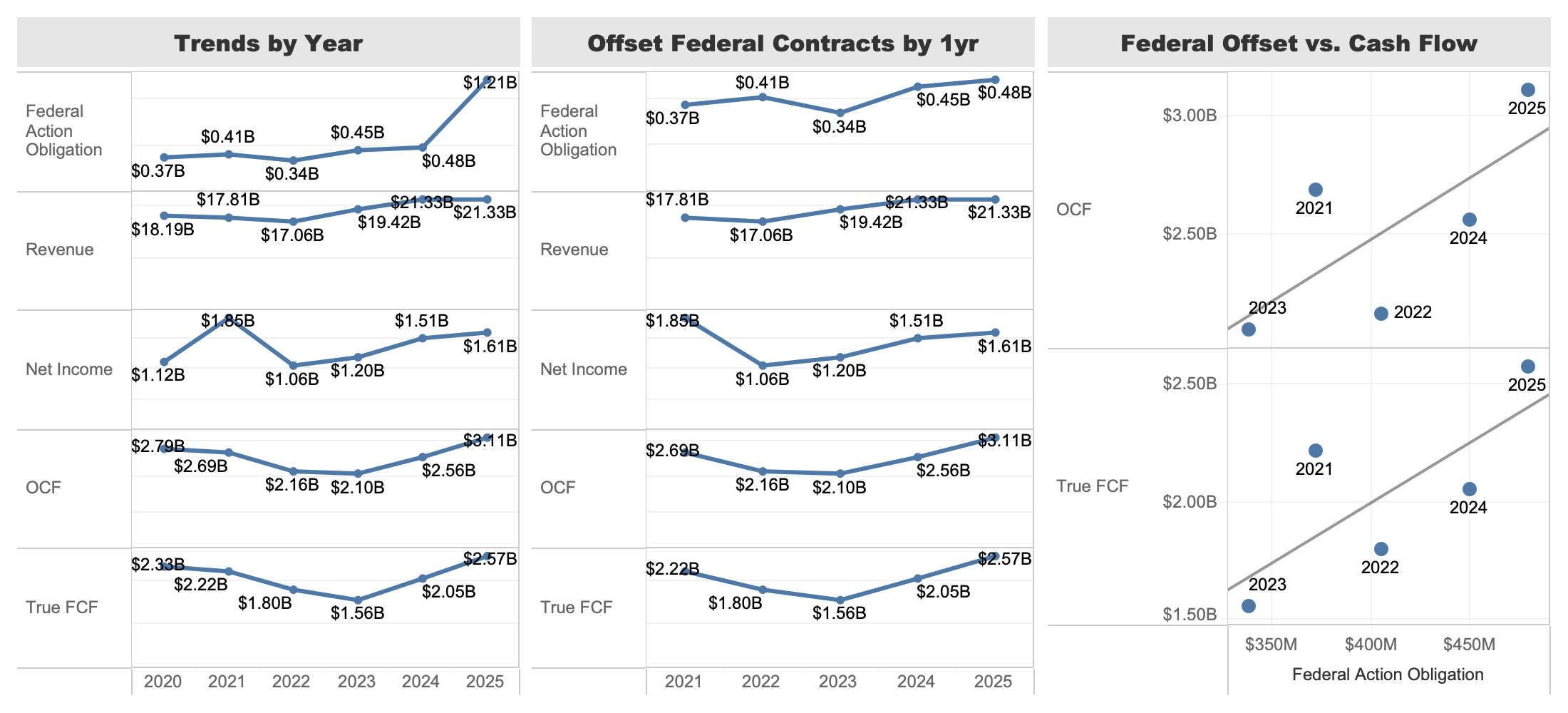
L3Harris (LHX, referred to in the data by its old name Harris Corporation) federal action obligations have spiked from a steady $400M-$500M since 2021 to $1.21B in 2025, but that doesn’t seem to be reflected in its price. Is the market missing something?

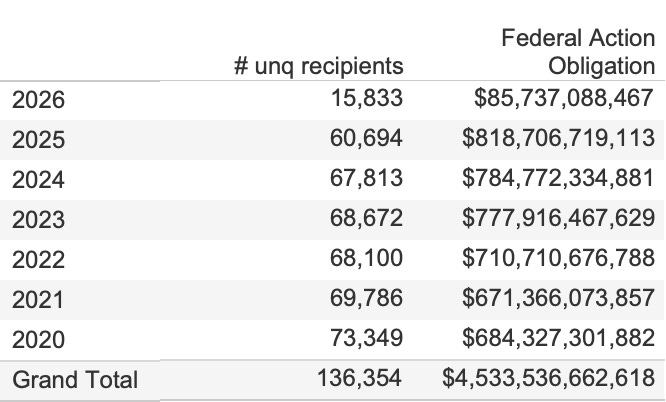
In my zeal to become an alt-data provider and ontologist extraordinaire, I decided to have a look at many gigabytes of USA spend data, government contracts and grants, to see whether there were insights that aren't easy to come by. The process of cleaning and understanding $4T of contract data since 2020 is challenging to say the least. But I’m finding too many nuggets to write about. If you want to see more results of this sort of alt-data analysis, please subscribe, or reach out to me if have other ideas for interesting sources of alt data.

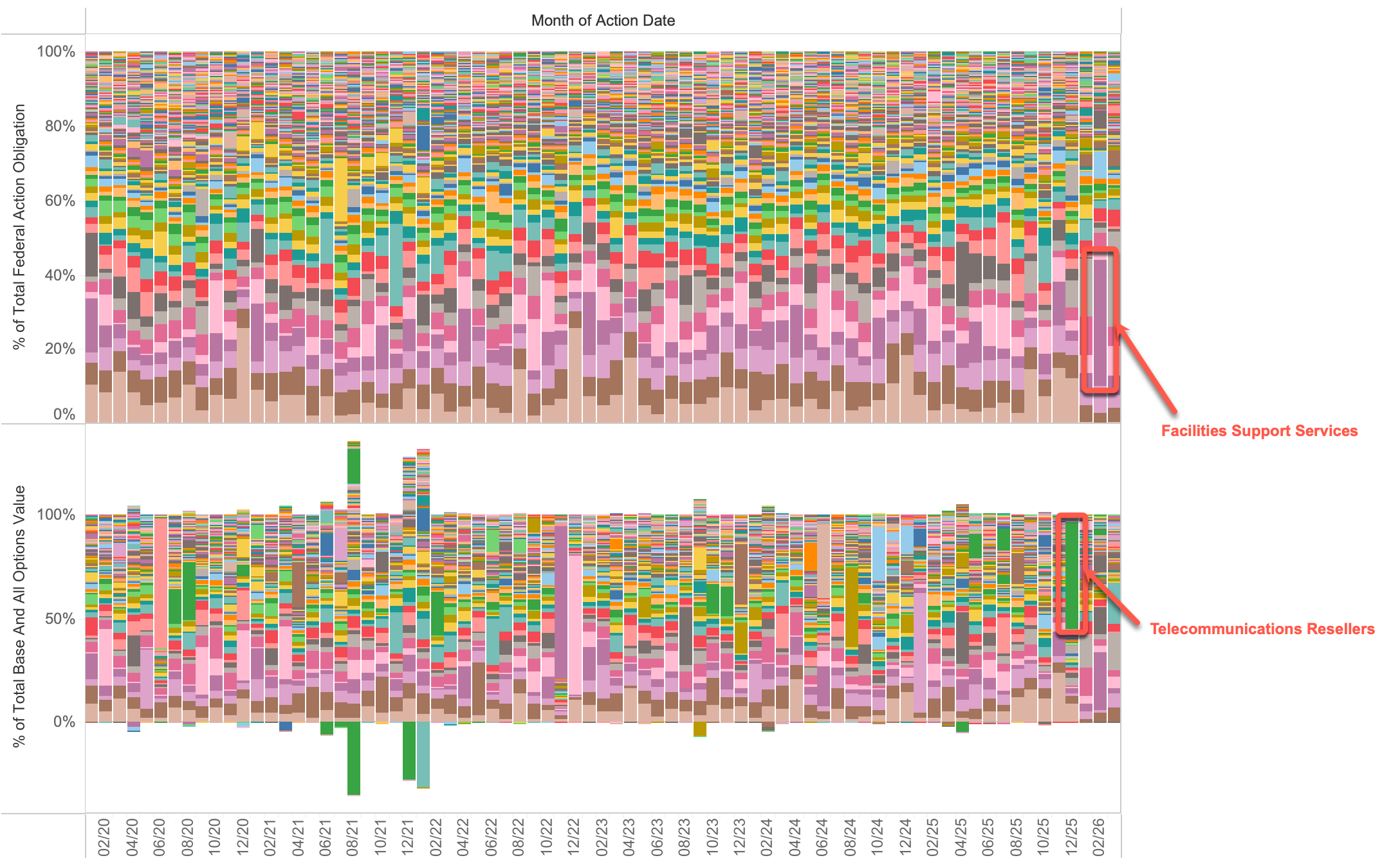
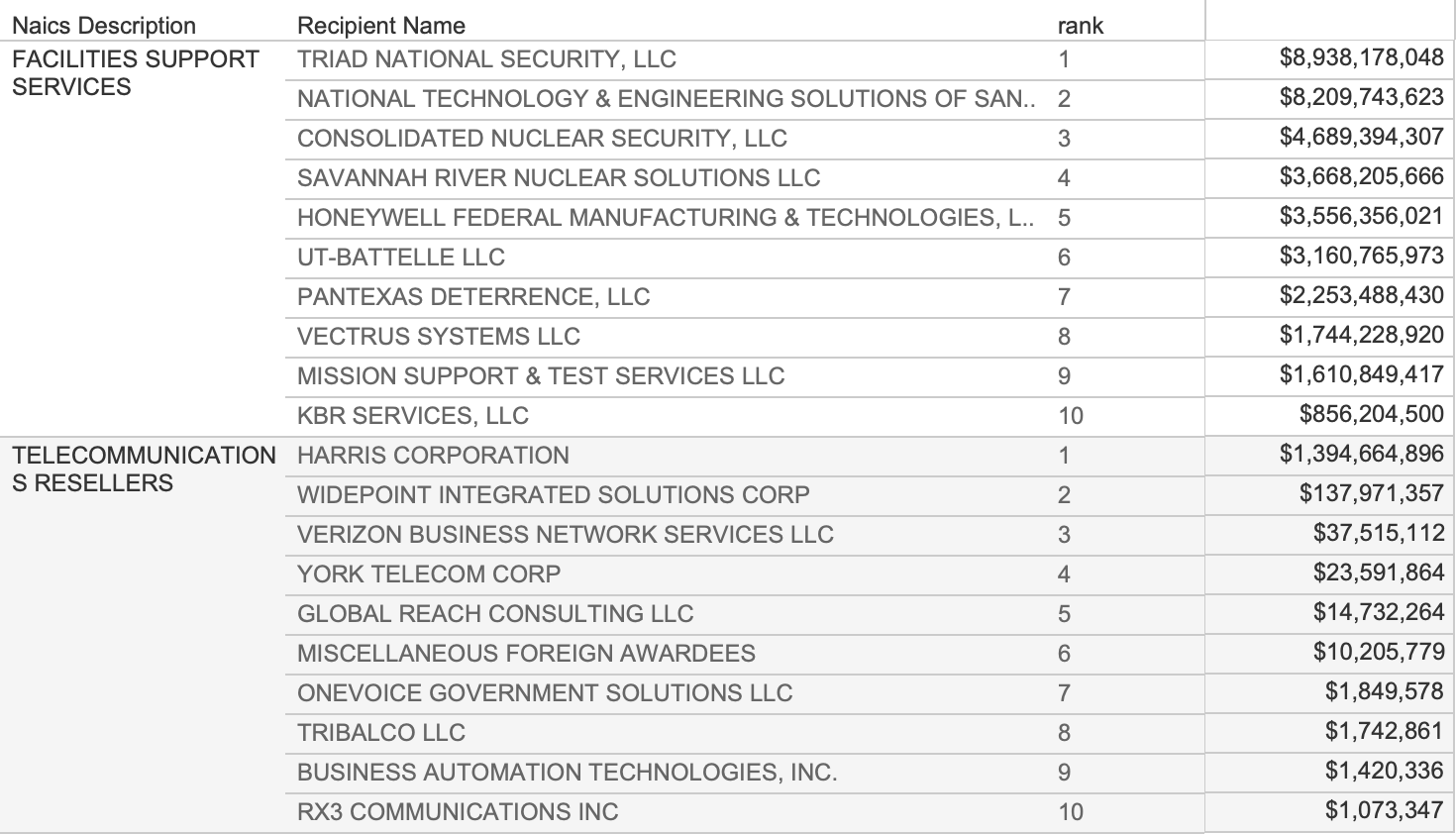
The first thing I do when understanding a dataset of vast scope is to try to pick out the outliers and see if they tell me anything. There are certainly a couple that stick out when looking at % of spend by industry classification (NAICS). In the total federal action obligations, I see a huge amount of “Facilities Support Services” in February 2026. In total base and options value I see another large amount for “Telecommunications Resellers”.

If the government is deciding to throw billions of dollars more into certain areas, I kind of want to know who will reap the benefits. Now we look at those two categories for the major players. Here are the top ten recipients by name for each of those NAICS descriptions in 2025-2026.

I’m looking for big outliers as well as potentially public companies. Two stand out that I know: Honeywell (HON) and Harris Corporation (now L3Harris, LHX). Now it’s a question of looking at their federal contract dollars over time. Both show some growth, though LHX is showing major growth from Q2 of 2025 until Q1 of 2026. That seems like enough ($300M+ per quarter) to have a material impact on LHX’s earnings.

The actual free cash flow numbers also seem related to future federal contracts obligations, as you’d expect. Based on that massive spike in 2025 obligations, you would expect LHX to have a lot of true free cash flow growth in 2026, which the market doesn’t seem to be pricing in. On the other hand, these obligations make up maybe 20% of LHX’s true FCF, only 5% of revenue. Not insignificant, but not everything. More broadly, however, the obligation data here does look predictive of true FCF, so we have some real alt data on our hands, it seems.

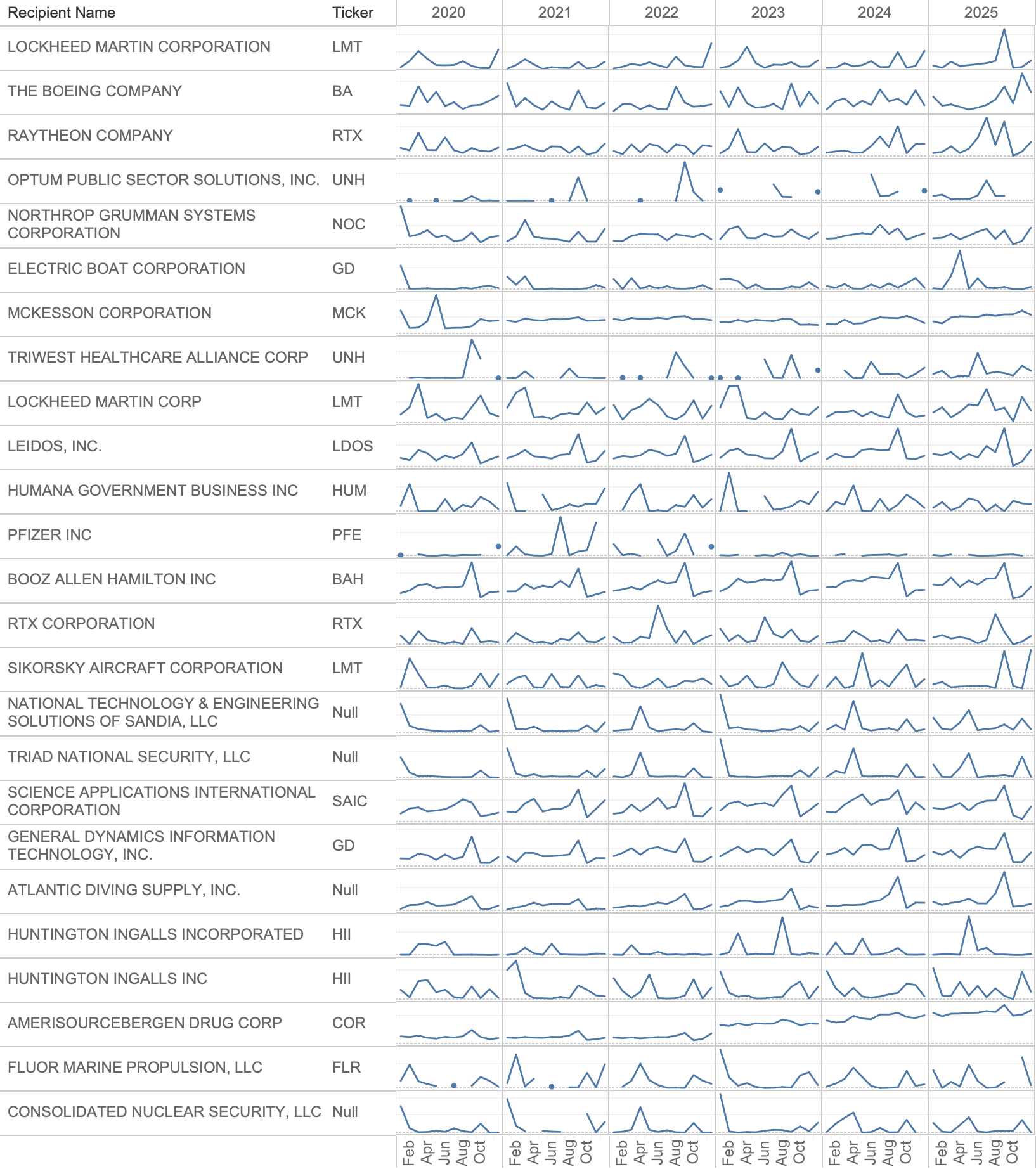
The conclusion from this? First of all, the promise of alt data that no one has ontologized is enormous, but it’s hard to find outside corroboration of whether the data are up to date or accurate. So if you see something here that you’d want to act on, do some research first to confirm or deny whether this data are already incorporated into the news about these companies. As to the promise, there are 136K entities in this data receiving money. Below are some of the trend lines by total contract action obligation for the top 25 entities listed. My hierarchical mapping from SEC subsidiaries to tickers seems to be working reasonably well so far. And look at Amerisourcebergen Drug Corp’s trend towards the bottom. That’s a great trend.

u/JoeInOR — 1 day ago
▲ 3 r/Investors+2 crossposts

Used USASpending.gov modification-level data to dig into LHX and HON — methodology and findings

I’m a data analyst and I’ve been building an alt-data pipeline on top of USASpending.gov — the federal contract database covering $4.5T in obligations since 2020. The data is free and public but almost completely unprocessed from an investment standpoint. This is my first writeup from it.

The methodology problem
The raw data has 297 columns, ~30M rows, and a terrible entity resolution problem. “Raytheon Company,” “Raytheon Applied Signal Technology Inc,” and “Raytheon Canada Limited” are all separate rows with no ticker attached. I built a mapping layer using SEC EDGAR Exhibit 21 subsidiary filings cross-referenced against recipient names. Imperfect but functional for major public companies.

What I found on LHX
Harris Corporation — the legacy name L3Harris still contracts under post-merger — had steady obligations of $400-500M annually from 2021-2024. In 2025 that jumped to $1.21B.

The driver is the FAA Telecommunications Infrastructure Next Generation contract. Civilian FAA modernization, nothing to do with DoD or DOGE. The modification-level data shows the pace accelerating through 2025: ~$100M in Q2, $265M in Q3, $310M in Q4.

LHX pulled back 9% from its March high on a backward-looking revenue miss. These FAA obligations are about 5% of LHX revenue and roughly 20% of true FCF. Not the whole story but not nothing either. The historical correlation between LHX obligation levels and subsequent FCF is reasonably clean.

What I found on HON
Honeywell FM&T runs the Kansas City National Security Campus — makes non-nuclear components for US warheads under DOE contract DE-NA0002839. Single modification amounts: $591M in Q2 2025, $509M in Q4, $989M in one modification in Q1 2026.
The HON correlation with FCF is noisier. Federal contracts are ~5% of their revenue and the scatter plot doesn’t tell a clean story. Worth watching given the restructuring but I wouldn’t act on it alone.

Palantir sanity check
Federal contracts are roughly a third of PLTR revenue. The correlation between obligation growth and their FCF metrics is strong and visually obvious. Good sign the methodology isn’t completely broken.

Honest caveats
30-90 day reporting lag on the data so recent quarters may be understated. The $90B FTI-NG ceiling figure comes from a single modification record and needs verification against primary FAA sources. I’m a data analyst not a contracting expert — if anyone has domain knowledge in FAA telecom or NNSA programs I’d genuinely appreciate a sanity check.

There are 136K entities in this database getting federal money. AmerisourceBergen’s trend is one I’m looking at next. Full writeup with charts here if you want to see the visuals: https://open.substack.com/pub/cavemanscreener/p/defense-contracts-and-fcf-looking?r=29p94e&utm\_medium=ios

u/JoeInOR — 3 days ago
▲ 27 r/BerkshireHathaway+1 crossposts

I correlated every Dividend Aristocrat's True FCF against NGDP. AXP came out #1. Buffett's second largest position. Here's the full data.

I got tired of P/E ratios so I built my own thing. 15 years of SEC XBRL data, True FCF (OCF minus CapEx minus SBC) for every Dividend Aristocrat, correlated against NGDP.

The finding that bothered me: 59% of Dividend Aristocrats have negative FCF/NGDP correlation. Their dividends aren't economic — they're structural. Clorox, Lowe's, JnJ — cash flows move independently of whether the economy grows or shrinks. That's either a moat or a warning depending on what you think comes next.

The three names that stood out:

AXP — 83% FCF/NGDP, 7% True FCF yield. Every Amex transaction is a clip on nominal GDP. Buffett's been sitting on this for decades. The screen explains why quantitatively.

CB — 10.2% True FCF yield, negative NGDP correlation. Countercyclical by design. Insurance underwriting profits when everyone else is bleeding.

KO — 78% revenue/NGDP, 18% FCF/NGDP. Revenue surfs the economy. Cash doesn't follow cleanly. Buffett bought it in 1988 when the True FCF yield was extraordinary. At 1.5% today the screen wouldn't touch it fresh. Neither would he.

Also ran 125 years of stocks vs gold vs the economy indexed to 100. The order surprised people in the comments last time I posted similar work — gold loses to NGDP badly. Stocks win on dividends alone.

Checked the math. Happy to share the truncated .csv. Link way down here: https://cavemanscreener.substack.com/p/surfin-ngdp-owning-the-necessaries

u/JoeInOR — 7 days ago
▲ 78 r/BerkshireHathaway+1 crossposts

We've all heard the AI capex story. I wanted to see the physical cash reality.

I got tired of net income headlines so I wrote a Python script to pull 16 years of SEC XBRL filings for every stock that's ever been in the S&P 500. I calculated True Free Cash Flow (Operating Cash Flow minus CapEx minus Stock-Based Compensation) for the Magnificent 7 to see who's actually printing cash and who's burning it building data centers.

Here's what the earnings releases aren't showing you:

The ugly:

  • Google's True FCF shrank from $47B to $46B while revenue grew 31%. CapEx nearly tripled — $32B to $91B.
  • Amazon's True FCF went negative in 2025 at -$11.8B. $131B in CapEx will do that.
  • Meta's True FCF fell 14% while Zuckerberg told everyone the AI bet was paying off.
  • Microsoft peaked at $63B True FCF in 2024, fell to $59.6B in 2025.

The exception: Nvidia. True FCF went from $2.9B to $56B in two years. They're the toll booth everyone else is paying.

The logical problem: The market is pricing all 6 as winners of an arms race where the math only works if at least one loses. Either CapEx spending ends at some point and they collect tolls like Buffett's bridge — or they keep feeding Nvidia indefinitely. Both sides can't win the bet simultaneously.

The P/True FCF multiples tell the real story. Google is at 86x. META is at 67x. These are growth prices for companies whose truest measure of cash generation is going backwards.

There's also a structural reason valuations stay this high despite the math — Gabaix and Koijen's inelastic market hypothesis. For every $1 of active buying, passive flows inject $5. Elon Musk knows this, which is why he wants SpaceX in the S&P 500.

Full 16-year charts on my Substack. https://cavemanscreener.substack.com/p/building-bridges-to-nowhere-the-magnificent

u/JoeInOR — 10 days ago
▲ 2 r/visualization+2 crossposts

I decided to step back a bit and try connecting to the full raw files I was able to pull from the SEC to see if any larger patterns emerged, and also to look for value in places other than the usual SaaS stocks.

For better or worse, what emerged from the mass data analysis with the most beautiful-looking historical trends were actually a couple of SaaS stocks (Salesforce $CRM and Roper $ROP).

When you look at the raw numbers, their increasing revenue is perfectly translating into increasing True Free Cash Flows, and even expanding margins. These companies have a massive runway of growth left, their moats are untouched, yet they have lost a lot of market cap recently because of “AI fears.” Personally, I think those fears are wildly overblown, and the physical reality of these graphs is why.

Here is how I view the AI panic as a data guy:

I build data ecosystems, and I do predictive modeling. Creating an ecosystem (software) lets me understand billions of rows of data cheaply and efficiently. Doing predictive modeling (AI) takes a massive amount of bandwidth and energy to profile a fraction of that data.

Software companies are cheap, scaled problem-solving. That’s why their margins are so high. Generative LLMs are heavy, energy-intensive problem-solving. Yes, LLMs will replace some software features. But LLMs need structured context to run efficiently. They need reams of deterministic data to give a halfway decent answer. That data will come from highly-profitable, scaled software fortresses like Salesforce and FactSet.

Wall Street is selling the cheap, high-margin software tollbooths to buy the expensive, low-margin AI power plants. I’ll gladly take the other side of that trade.

Looking outside of tech, a few other non-SaaS outliers showed up on the grid that tell an interesting story. $BLDR (Builders FirstSource) spiked mid-COVID when everyone wanted a bigger home, but with its cyclical nature and high rates, I’m cautious. $WTRG (Essential Utilities) sticks out to me, though. Anything with fat margins, lots of yield, steady growth, and the word “essential” in the name seems like a great place to hide right now.

This isn’t a deep dive into any single ticker. It's more of a proof-of-concept for how we can visualize massive amounts of SEC data to expose outliers, avoid value traps, and find the real cash generators.

For the actual visuals (scatterplots and time-series grids), I put the write-up on my Substack here:https://cavemanscreener.substack.com/p/the-power-of-screening-with-raw-data

If anyone wants to play with the raw dataset I used to build this, just drop me a message and I’ll send you a cut (I'm also building it into a web app so I don't have to keep running Python scripts). Curious if anyone else is buying the SaaS dip right now.

u/JoeInOR — 15 days ago
▲ 37 r/ValueInvesting+1 crossposts

We’ve all heard the narrative: the "SaaS-pocalypse" is here, and AI agents are going to destroy software seat usage. I hold the conflicting belief that the market usually knows more than I do, but I wanted to see the physical reality.

I got tired of Wall Street's "Adjusted EBITDA" nonsense, so I wrote a Python script to ingest 15 years of SEC filings for 1,400 stocks. I calculated True Free Cash Flow (Operating Cash Flow minus CapEx minus Stock-Based Compensation) to see who is actually printing physical cash, and whose moat is eroding.

I cross-referenced True FCF Yield against 5-year FCF compounding and margin expansion. Here are the three most violent macroeconomic divergences in the market right now:

1. The Screaming Buy: Workday ($WDAY) The stock is down -50% over the last year. Wall Street thinks the HR software cycle is dead. But the math says they are yielding 7%, and they compounded Free Cash Flow at 40% a year for the last 5 years. The physical moat is completely intact, and you are getting it for half price.

2. The Value Trap: Gen Digital ($GEN) It screens at the very top of my list with a mouth-watering 18% FCF yield. But the script flagged a terminal decline: their 5-year margin CAGR is -24% and top-line revenue is shrinking. The yield is high because the market correctly assumes it's a melting ice cube losing to CrowdStrike and MSFT Defender.

3. The "AI Context" Play: FactSet ($FDS) FactSet has been punished by the market (down -46%), pushing its True FCF yield to 7%. But as someone who works in data science, I can tell you LLMs are useless without structured context. FactSet owns the proprietary context of the stock market. It has rock-solid top-line growth (~9%), and Wall Street is throwing it away.

The Takeaway: The market is right that some SaaS is dying, but it's throwing out the compounding monopolies with the bathwater.

Note: I couldn't format the massive 10-year data tables and the full list of 30 stocks on Reddit, so I put the raw data, the charts, and the $CRM breakdown on my Substack here if anyone wants to check my math: https://cavemanscreener.substack.com/p/saas-value-traps-and-ai-context-by

u/JoeInOR — 17 days ago