u/Hermes-Astro

The 8-Year Venus Returns

The 8-Year Venus Returns

Venus returns to its natal position in two rhythms. The annual return, occurring every nine to twelve months, is like a personal Valentine’s Day. For a few days, your Venusian nature becomes more available and conscious.

The deeper rhythm is the eight-year return. Because Venus and Earth orbit in a 13:8 resonance, in the time it takes Earth to orbit the Sun eight times (8 years), Venus orbits the Sun thirteen times. This creates a powerful repeating pattern in the sky, often visualized as the Pentagram (or Rose) of Venus—a five-petaled flower traced by Venus’s motion from Earth’s perspective over those eight years.

Every eight years, Venus and the Sun are approximately at the same degree. For example, if at age 8 during your Venus return, the Sun was at 7° Pisces, you will find that every eight years—at ages 16, 24, 32, 40, 48, 56, 64, 72, and so on—the Sun will be around that degree, while in the other years of the Venus return it will fall in other zodiac signs.

The first eight-year Venus return—at age eight—serves as the template for adolescence. The aesthetic preferences that emerge, the first genuine friendships, and the first conscious narrative of self-worth all echo throughout your life. If your sense of style was encouraged at eight, you learn to expect that your taste matters throughout your life. If it was mocked, you may expect that your preferences should be hidden. If you formed a genuine friendship, you expect that chosen love is possible. If you were rejected, you may anticipate rejection in the future.

Your Latest Eight-Year Venus Return

Analyze your latest eight-year Venus return in both the natal chart—with transits—and the standalone chart. To understand your Venusian life at any age, you must first understand what happened at your latest eight-year Venus return.

Venus signifies attraction, beauty, sensuality, and the pleasures of life—along with finance, relationships, and marriage. In the body, it rules the voice, speech, hair, eyes, face and the paired organs such as kidneys and ovaries.

In a male chart, Venus is also the significator of the wife. It governs amusements and the arts, dancing, charm and sociability. It reflects one’s ability to enjoy life, care for the body, and value comfort through things like clothes, comforts and conveyances.

Venus is the significator of every dimension of relationships—sex, love, lust, infatuation, romantic idealism, and affairs.

Case Study: Brad Pitt

Brad Pitt and Angelina Jolie met in 2004 while filming Mr. & Mrs. Smith, when Brad Pitt was 41 years old, right after his 8-year Venus return at age 40. The relationship was thriving, and they became the most glamorous couple in Hollywood, famously called “Brangelina.”

At the following 8-year Venus return, at age 48 in 2011, the return chart gave cloudy indications about his relationship with Angelina Jolie. Indeed, relationship tensions began mounting from 2014, and they ultimately divorced in 2016.

In the stand-alone the return chart (right), the Return Ascendant (Pisces ♓), which describes the overall atmosphere of the upcoming 8-year Venus cycle, was dominated by challenging influences that make maintaining a harmonious marriage difficult:

  • Chiron (⚷)
  • Mars (♂)
  • Mercury (☿) in detriment and combusted by the Sun (☉)
  • Black Moon Lilith (⚸)
  • Uranus (♅).

Conclusion

Without awareness, we often live reactively—carried by daily circumstances and driven by forces we don’t fully recognize. But with awareness, we gain the ability to respond intentionally, bringing the subconscious into the light so we can navigate difficult seasons with clarity and purpose.

That’s why we study astrology in depth: not to predict life, but to understand ourselves more deeply—so we can live a better, more deliberate one.

Source: Mastering Astrological Returns: A Complete Interpretive System for the Moon, Sun, Mercury, Venus, Mars, Jupiter, Saturn, Lunar Nodes, Lilith, and Chiron

u/Hermes-Astro — 2 hours ago

The 4th House in Astrology Meaning

The 4th House represents your foundation — home, family, and inner security. It reveals the roots that shape your emotional and material world. Let’s break it down:

🏡 Home & Comfort

  • Your personal sanctuary and home environment
  • Spaces where you rest and recharge
  • Comforts and luxuries that make a house feel like home
  • Childhood home, owned or stewarded properties
  • Vehicles (your private, mobile space)

❤️ Family & Emotional Life

  • Relationship with your mother or maternal figures
  • Emotional sensitivity and inner well-being
  • Deep ties to your heritage and roots
  • Emotional security and stability

🧠 Health & Body

  • Upper chest, lungs, and heart
  • Upper spine and posture
  • Breasts and related physical health

📚 Education & Life Milestones

  • Diplomas and licenses
  • Foundational education (from primary school through university-level training for a profession, e.g., becoming a doctor)

🌍 Roots & Belonging

  • Home country
  • Sense of patriotism and national identity

The 4th House is your emotional anchor — the soil from which your entire life grows. Nurture it, and you nurture yourself. 🌱

Sources:

The Astrologer’s Guide: Mastering Birth Chart Interpretation

House Systems and Derivative Houses in Astrology

u/Hermes-Astro — 1 day ago

We are drawn toward what fascinates us, what excites us, what resonates with the deepest layers of our being

In life, we often imagine that progress comes from pressure—from someone pushing us, urging us to act, to strive, to succeed. But the truth is more subtle, more magnetic. Life moves us forward not because of force, but because of attraction. We are drawn toward what fascinates us, what excites us, what resonates with the deepest layers of our being. To understand what truly calls you, it helps to look at the sky above the day you were born, because the planets in your birth chart offer clues about your subconscious mind. Your birth chart provides a map of the energies that pull at your heart and influence your actions.

Three points in particular can illuminate this inner pull: Venus, Mars, and the North Node. Venus, the planet of love, beauty, and desire, shows what you are naturally drawn to. It points to the values and experiences that make your soul come alive. Mars, the planet of drive, courage, and action, reveals what motivates you to act, what stirs your passions, and what fuels your determination. Together, Venus and Mars trace the dance between what delights you and what compels you.

Then there is the North Node, the karmic compass of your chart, hinting at the lessons your soul seeks to learn in this lifetime. It is less about immediate desire and more about the long-term pull, the path that calls you forward toward growth and fulfillment. While Venus and Mars can describe your present attractions, the North Node points to your destiny, the gravitational center that subtly shapes your journey.

Exploring these three planets* can reveal a fascinating pattern: the things that enchant you, the things that ignite your courage, and the life path that pulls you forward. Understanding them doesn’t force your hand, nor does it promise a rigid roadmap. Instead, it clarifies the magnetic currents in your life, helping you recognize what calls to you, what inspires you, and what feels so naturally aligned that moving toward it feels like breathing.

Life is less about being pushed and more about following the pull. The stars offer hints of that pull, a cosmic guide to the things that make your heart quicken, your mind expand, and your spirit rise.

*Check the sign, house, and the aspects they receive, starting with the Tropical zodiac and the Whole Sign house system. If it doesn’t resonate with you, you may need to switch to the Sidereal zodiac and to other house systems. Remember that birth chart settings are personal and not the same for everyone. Use this link on Astro.com.

Source: The Astrologer's Guide: Mastering Birth Chart Interpretation

u/Hermes-Astro — 2 days ago

Astrology Yes or No (May 11, 2026)

♇ Pluto just turned retrograde in ♒ Aquarius and suddenly everyone is questioning their entire personality online.

♅ Uranus entered ♊ Gemini two weeks ago and people are already:

  • changing careers
  • deleting social media
  • oversharing
  • starting podcasts
  • texting their ex “for closure”

Meanwhile ♄ Saturn in ♈ Aries is saying: “Grow up.”

♂ Mars in ♈ Aries is saying: “No.”

⚷ Chiron in ♈ Aries is saying: “But what if we heal first?”

☽ Moon conjunct ☊ North Node in ♓ Pisces feels like:

  • crying because of a song
  • having prophetic dreams
  • wanting to disappear into spirituality
  • pretending you’re fine while absorbing everyone else’s emotions

♉ Taurus season is trying to save us.

☉ Sun + ☿ Mercury in ♉ Taurus: “Please eat something, touch grass, and stop making life harder than it needs to be.”

♀ Venus in ♊ Gemini is peak: “I like you… but also I’m bored… but also text me back immediately.”

♃ Jupiter in ♋ Cancer makes people extra emotional about:

  • family
  • memories
  • home
  • people from the past
  • comfort food

And ♇ Pluto retrograde at 5° ♒ Aquarius?

The collective identity crisis has officially begun.

Current energy:

  • wanting freedom but also security
  • healing but angrily
  • spiritual awakening mixed with doomscrolling
  • saying “new era” every 3 business days

Horoscope: Yes or No?

♈ Aries — YES

You’re bold, brave, and impossible to stop right now. The universe is rewarding courage. Just maybe don’t start arguments for entertainment.

♉ Taurus — YES

Comfort, peace, food, money, naps. Your season is carrying the collective. Keep building slowly instead of rushing.

♊ Gemini — YES… BUT

You’re magnetic right now, but your attention span is fighting for its life. Great for flirting, bad for commitment.

♋ Cancer — YES

♃ Jupiter in your sign is making you softer, luckier, and more emotional. Home, family, and healing matter more than status now.

♌ Leo — YES

People are noticing you again. Stop pretending you don’t enjoy attention. Confidence works in your favor this week.

♍ Virgo — NO

☋ South Node in your sign is exposing burnout and overthinking. You do not need to fix everyone and everything immediately.

♎ Libra — YES… BUT

Set boundaries first. Stop saying yes when your soul clearly said no three business days ago.

♏ Scorpio — NO

Not every feeling needs to become a dramatic investigation. Protect your peace and stop reading hidden meanings into everything.

♐ Sagittarius — YES

Adventure energy is strong. Random opportunities, spontaneous plans, and chaotic good decisions somehow work in your favor.

♑ Capricorn — YES

Slow progress is still progress. Discipline wins over motivation right now. Stay focused and ignore distractions.

♒ Aquarius — YES… BIG YES

♇ Pluto retrograde in your sign is transforming your identity completely. You’re becoming a different person in real time.

♓ Pisces — YES

☽ Moon conjunct ☊ North Node in your sign = intuition overload. Dreams, signs, coincidences, and emotional clarity are trying to guide you.

u/Hermes-Astro — 3 days ago

Diagnostic vs. Karmic Astrology

In the latest post, we examined Strangers: A Memoir of Marriage, the story of a woman whose twenty-year marriage dissolved with a suddenness that left her—and everyone who knew the couple—genuinely bewildered. How does someone you have shared a life with become, in what feels like a single moment, someone you do not recognize?

The astrological answer, as we argued, is that when one or more weaknesses in a birth chart are paired with afflictions, they eventually manifest during the course of life—and in some cases, can significantly disrupt a person’s life.

Broadly speaking, there are two types of issues in life. The first type is the kind we are already aware of—for example, realizing that finding a partner is challenging or noticing that, regardless of who may choose, the same patterns keep repeating.

The second type is dormant issues, like those uncovered by the author of Strangers. These issues may remain hidden until transits “bring them to the surface”.

Typically, people consult an astrologer for the first type of issue. They try various solutions, and a birth chart reading becomes a last resort. People generally only explore this deeper layer once the “obvious” solutions fail.

For the second type, however, seeking guidance may already be too late. Once the problem emerges—as in the case of Belle Burden’s husband communicating that he is leaving the family—there is little that can be done. He had been ruminating for months, or even years, and the decision was irreversible. Being able to read your own birth chart—and the charts of those around you—can help address issues while they’re still developing.

Both types of cases require karmic work.

Diagnostic Astrology vs. Karmic Astrology

Most astrologers are trained primarily in making diagnoses. They examine a birth chart and explain why a certain area of life isn’t functioning well or has come to a standstill—perhaps because a related house is afflicted, its ruler is weak, the significator is poorly placed, or challenging transits are occurring. That’s it. They are like a doctor who looks at your lab results and tells you what illness you have—but doesn’t provide a prescription. It’s just diagnosis without treatment.

In some cases, simple awareness can be helpful, but in many others, it may not be enough:

Awareness doesn’t automatically create agency.

Knowing why something is stuck (e.g., “Your 7th house ruler is debilitated and retrograde”) doesn’t tell the person what to actually do today, tomorrow, or next week. Without actionable steps, insight can turn into resignation or paralysis: “My chart says this area is doomed, so why try?” This can reinforce the feeling of being “stuck in my nature.”

Confirmation bias can worsen problems

If all an astrologer does is confirm a client’s fear (“Yes, your career house is afflicted”), the client may unconsciously act out that story, making the problem worse. Therefore, astrology becomes a self-fulfilling prophecy instead of empowerment.

Planetary returns and transits are underutilized

Many astrologers will note, “Pluto squares your natal Sun this year—transformation ahead,” but stop there. There is work that needs to be done, but the client is left to figure out what that work is on their own.

karmic astrologer, by contrast, goes a step further. They not only aim to make an accurate diagnosis—pinpointing the planets or houses responsible for the issue*—but also provide guidance on the kind of karmic work needed to address it.

*Remember that planets and houses describe the subconscious mind of an individual.

To Learn more about Karmic Astrology check out this book on Amazon.

u/Hermes-Astro — 4 days ago

Why is Today (May 9, 2026) so Bad Astrology?

Buckle up, besties, because the sky is NOT serving cunt today. It’s serving an IRS audit during a mental breakdown. Here’s why May 9, 2026, is astrologically garbage 🔥🗑️

1. PLUTO RETROGRADE IN AQUARIUS (5°) JUST STARTED
Pluto went retrograde on May 7, aka 2 days ago. So we’re all digging up our deepest shadow wounds about the future, technology, and belonging. Not healing. Digging. With a rusty spoon.

2. URANUS JUST ENTERED GEMINI (0°) on April 27
Welcome to 0° chaos. Uranus at 0 Gemini = sudden, unhinged communication breakdowns. Your texts? Delivered but not read. Your group chat? A war crime. Your internet? On fire.

3. SATURN IN ARIES (10°) + MARS IN ARIES (23°) = DOUBLE ANGER DADDY
Saturn says “discipline your rage.” Mars says “punch a wall.” They’re both in Aries, so you’re frustrated, impulsive, and guilty about it. Square? No. Conjunct? No. Just… two angry planets breathing the same fire air. Exhausting.

4. MOON IN AQUARIUS (16°) – LAST QUARTER MOON
The Full Moon in Scorpio was May 1 (death/rebirth energy). Now we’re at Last Quarter = crisis of consciousness. Moon in detached Aquarius + Pluto retrograde = you feel nothing until you suddenly feel everything at 3 AM.

5**. TRANSITIONS (27°–3° = THE VOID ZONE OF DOOM)**

  • Chiron at 27° Aries → about to hit 0° Taurus. Wounded healer leaving fire impulsivity for earth stubbornness. You will heal by finally stopping, and you’ll hate it.

Dignity check (lol):

  • Sun in Taurus (exalted? no, but fixed earth = stubborn peace)
  • Moon in Aquarius (detriment lite™)
  • Mercury in Taurus (not bad but slooooow)
  • Venus in Gemini (in her flop era)
  • Mars in Aries (domicile but too much)
  • Saturn in Aries (fall) — RIP boundaries.
  • Pluto in Aquarius (modern co-ruler but retrograde = blocked)

Verdict:
The last quarter moon is asking “what have you learned since the Scorpio full moon?” and the answer is nothing because Uranus is glitching your brain, Saturn is failing at discipline, and Pluto is resurrecting your 2019 trauma. Stay inside. Don’t text your ex. Don’t start a business. Don’t cut your own bangs.

TL;DR: May 9, 2026 = astrological hangover from hell with a side of identity crisis. 💀

Upvote if your birth chart already had trust issues.

u/Hermes-Astro — 5 days ago

Belle Burden’s “Strangers” Through an Astrological Lens

Strangers: A Memoir of Marriage is topping bestseller charts. It’s a personal, emotional work of nonfiction that tells the story of a woman trying to understand how her long marriage suddenly fell apart. At its heart, it asks a disturbing question: can someone you’ve shared a life with become a stranger almost overnight?

The Rough Timeline in Strangers

1. Early pandemic (March 2020) — everything seems normal

They are together as a family on Martha’s Vineyard—cooking, drinking, and settling into lockdown life. From her perspective, the marriage feels stable and intact after 20 years of partnership.

2. The rupture — he announces he’s leaving

Out of nowhere, her husband tells her he is leaving.

There is:

  • no clear buildup
  • no satisfying explanation
  • rapid emotional withdrawal

What follows is not a slow separation—it feels like a sudden emotional cutoff, as if the relationship has been switched off.

3. Immediate aftermath — confusion and shock

Right after he leaves, she is left dealing with:

  • caring for their children (3)
  • trying to understand what just happened
  • replaying the marriage in her mind

This stage is deeply disorienting. The central question becomes:

Was any of it real?

4. Looking backward — searching for clues

As time passes, Burden begins to reexamine the marriage:

  • moments that may have hinted at deeper fractures
  • her own role in maintaining stability
  • the expectations she absorbed about being a “good” wife

The memoir becomes less about the departure itself and more about reinterpretation and self-inquiry.

Core Questions the Book Explores

  • Can you ever fully know another person?
  • Are there invisible cracks in relationships we ignore?
  • What happens to identity when a long-term marriage collapses suddenly?

Investigating Similar Cases: Gisele Bündchen and Kim Kardashian

Both are examples of long-term relationships where the breakup appeared sudden from the outside, even if it wasn’t internally abrupt.

Tom Brady & Gisele Bündchen

  • Two children together
  • Divorce finalized in 2022
  • Public perception: sudden rupture
  • Underlying tension: long-standing conflict, especially around career vs. family priorities

Kim Kardashian & Kanye West

  • Four children together
  • Divorce filed in 2021
  • Public perception: decisive break after escalating strain
  • Underlying tension: behavioral changes, instability, and long-term incompatibility

Astrological Analysis - Part 1: The Wife’s Birth Charts

https://preview.redd.it/11acskp6qozg1.png?width=540&format=png&auto=webp&s=7398c8b2ac3d61a0be52739b848426f6eb723e3c

Jupiter is the significator of the husband. In the natal charts of both Kim Kardashian (left) and Gisele Bündchen (right)—both recorded with AA-rated birth data in Astro-Databank—Jupiter is weakened and under affliction by Saturn.

Jupiter ♃ placed in Virgo ♍ is classically regarded as being in debilitation. In this position, Jupiter’s natural significations—trust, expansion, generosity, and emotional faith in the continuity of a bond—do not express themselves freely or naturally. Instead, they become filtered through Virgoan qualities of analysis, critique, practicality, and constant evaluation. This can manifest as a tendency to over-analyze the relationship rather than rest within it, where emotional surrender is replaced by mental processing, and relational ease is substituted with ongoing assessment and subtle doubt.

In addition to this debilitation, Jupiter is afflicted by Saturn ♄ in both charts. Saturn represents delay, restriction, emotional cooling, separation, structure, and karmic pressure. When Saturn strongly influences Jupiter, the emotional dynamics of a relationship may gradually contract over time. Rather than a sudden rupture appearing without cause, the separation is interpreted as the culmination of a slow and often imperceptible process—characterized by emotional withdrawal, increasing duty-bound behavior, dissatisfaction that is not openly expressed, or a growing sense of internal distance.

Such relationships cannot be embraced effortlessly or lightheartedly. Instead, they require conscious and sustained effort in order to preserve emotional warmth, trust, and continuity. The relational bond does not remain stable on its own momentum.

These relationships demand karmic work*, meaning the deliberate strengthening of Jupiterian qualities while simultaneously managing or pacifying Saturnian influence.

Without this active equilibrium, Saturnian influence gradually overtakes Jupiter’s capacity to sustain warmth and relational cohesion. As this imbalance develops, the relationship slowly transitions from closeness to distance, and eventually to separation. From an external viewpoint, this shift can appear sudden or unexpected; however, it is the visible expression of a much longer, subtle, and cumulative internal process.

*We will delve into karmic work in the next post.

reddit.com
u/Hermes-Astro — 7 days ago

Astrological Transition Points in the Birth Chart

These are the degrees, axes, and thresholds where one astrological energy ends and another begins. They are the fault lines of the psyche, the hidden doors where your personality shifts from one mode of being to another. To ignore them is to miss half the story of who you are.

Here is a guide to the most critical transition points in your birth chart and why they hold the key to your spiritual wiring.

The Cardinal Points: 0 and 29 Degrees

Every sign has 30 degrees, but the first and last degrees are special. They are the unstable ground.

The 0 Degree (The Aries Point): If you have a planet at 0 degrees of any cardinal sign (Aries, Cancer, Libra, Capricorn), you have a planet at the "Aries Point." This is a point of raw initiation. These people don’t follow trends; they start them. However, there is a cost. A planet at zero degrees lacks the solidity of the middle degrees. It feels raw, exposed, and constantly ready to jump into a new identity.

The 29th Degree (The Anaretic Degree): This is the master’s degree. Often called the "crisis degree," 29° carries the wisdom of an elder trapped in the impatience of a child. If you have a planet here, you have finished the karma of that sign. You are an expert, but you are sick of the lesson. You want to burn the house down just to feel something new. People with 29° placements often experience sudden, last-minute reversals of fortune.

The Cusps: The Great Debate in Astrology

The most controversial transition point is the "cusp"—born when the Sun is between 27° of one sign and 3° of the next. Purists say you are one sign or the other. Life says it is messier than that.

If you are a "cusp baby," you are not two signs mixed together. You are a fusion reaction. These souls have mastered one energy so completely that they are already borrowing the tools of the next.

  • The Capricorn-Aquarius cusp (Jan 16-22): The "Mystic Rebel." You have Capricorn’s discipline to build structures, but Aquarius’s urge to tear down the establishment.
  • The Pisces-Aries cusp (Mar 17-23): The "Cusp of Rebirth." You are the dreamer who wakes up swinging. You have Pisces’ empathy and Aries’ ruthless survival instinct.

Living on a cusp means your identity is never static. You are always transitioning, always becoming.

The Angles: The Horizon Lines

Your birth chart is a circle split by two invisible lines: the Horizon (Ascendant/Descendant) and the Meridian (Midheaven/IC). These are the most potent transition points because they are the edges of reality.

The Ascendant (Rising Sign): This is the transition from the unconscious to the conscious. It is the mask, but also the filter. As you move from the 12th House (the unconscious) across the Ascendant into the 1st House (the self), you are literally crossing the threshold into the waking world. How you handle that transition defines your first impression on others.

The Midheaven (MC): This is the transition from the private home (4th House) to the public arena. It is the highest point in the chart. Planets here are going "over the top." They act as a hinge: what you do in public (MC) is a direct reaction to how you were raised at home (IC). When a transiting planet crosses your Midheaven, your reputation undergoes an immediate transition.

The Nodes of Fate: The Great Transition of Life

If other transition points are about personality, the Lunar Nodes (North and South Node) are about the transition of the soul over a lifetime.

  • The South Node: Where you are coming from. The comfortable, old energy. The exit ramp.
  • The North Node: Where you are going. The terrifying, necessary energy. The on-ramp.

The transition happens at the exact degree of the Node. Until you master the South Node’s lessons (the exit), you cannot accelerate into the North Node’s future. Every few years, the Nodes change signs, shifting the collective’s transitional direction, but your birth Nodes are your personal spiritual timeline.

Planetary Stations: The Pause at the Gate

Finally, consider the transition points of motion: retrograde stations.

When a planet slows down to turn retrograde (or direct), it sits at a specific degree for several days. If that degree touches a planet in your chart, you experience a "station." This is the ultimate transition point—time stops. The planet is neither moving forward nor backward. It is a pressure cooker.

Having a natal planet conjunct a station degree (like Mercury at 22° retrograde) means you are a conduit for that planet’s raw, unfiltered energy. You don’t learn communication; you are communication.

How to Work With Your Transition Points

These are not weaknesses. They are your flexibility joints. Where others are rigid in one sign, you have the ability to pivot. You are the person who can walk between worlds—who can be the serious adult and the playful child in the same breath.

In a static universe, life would be easy. But astrology is the study of motion. Your transition points are where the movement happens. They are the cracks in the armor where the light gets in.

Embrace the threshold. After all, you were never meant to stay in one sign forever. You were only meant to know where you started—so you could map out where you are going.

u/Hermes-Astro — 8 days ago

Pluto just went retrograde in Aquarius ♒ (May 6 - Oct 15/16) and my trauma is already filing a formal complaint

Pluto stationed retrograde TODAY at like 5° Aquarius and he's about to moonwalk backwards until mid-October. That's 5+ months of the planet of death, rebirth, power struggles, and "why am I like this" doing the most in the sign of the future.

Translation:

  • Your ex from 2024 is NOT coming back but your unresolved daddy issues from 1783 might
  • The group chat you ghosted is about to expose your entire bloodline
  • Technology is glitching your soul in 4K
  • "I don't need therapy I have astrology" is no longer a valid coping mechanism

This retrograde is basically Pluto saying: "You thought you were done transforming? Cute. Let's revisit every skeleton in your closet and make them do the Macarena."

Expect:

  • Sudden realizations that your "rebellious" phase was actually just capitalism's puppet strings
  • Friend groups imploding like they're in a reality show
  • That one Aquarius placement in your chart having an existential crisis in public

How's everyone feeling already? Has your power been stripped, your secrets aired, or are you peacefully pretending this doesn't apply to you (it does)?

Drop your sign + what fresh hell Pluto is dragging up for you rn. I'll start: Scorpio rising and my entire personality is under construction, send help (or Plutonium).

#MemeAstrology #PlutoRetrograde #AquariusSeasonButMakeItTrauma #WhyIsHeBackwardsAgain

(Upvote if you're already journaling at 3am about societal collapse and your fear of intimacy)

reddit.com
u/Hermes-Astro — 8 days ago

The Lot of Fortune in Action 🍀🎯

Most people come to astrology looking for themselves in the planets. They want to know what their Sun says about their identity, what their Moon reveals about their emotional life, what Venus and Mars suggest about love and desire. These are reasonable places to look, and the planets deliver. But there is a point in the chart that most modern astrologers have either forgotten or dramatically underestimated — a point that does not belong to any planet, that cannot be seen in the sky, and that reveals something the planets cannot: the specific quality of fortune as a living presence in your life. That point is the Lot of Fortune, and once you understand what it actually describes, you will never read a chart the same way again.

What the Lot of Fortune Actually Is

The Lot of Fortune — called Tyche in Greek, after the goddess of fortune and chance — is a calculated point derived from the relationship between three of the most important positions in the chart: the Sun, the Moon, and the Ascendant. The result is a sensitive point that carries within it the combined signature of all three foundational chart factors — the solar purpose, the lunar emotional life, and the incarnational path of the Ascendant — compressed into a single degree that describes the terrain of material circumstances as they actually unfold across a lifetime.

This is the first and most important thing to understand about the Lot of Fortune: it does not describe who you are. It describes the ground you walk on. It does not speak to your intentions, your values, your inner life, or your sense of purpose. It speaks to circumstances — the material and physical quality of your existence, the nature of the opportunities that arise and the obstacles that complicate them, the texture of luck as it moves through your life. The Lot of Fortune is where astrology gets honest about the fact that not everything is within your control — that the terrain of a life is shaped by forces larger than the individual will, and that understanding those forces is as important as understanding the self that has to navigate them.

The Lot of Fortune is one of the Five Places of Life and serves as a primary indicator of the quality of one’s material existence. It reflects the body’s condition and the nature of one’s prosperity. More than that, it embodies the dimension of fate—the unexpected circumstances that arrive uninvited, and the specific character of the material world as it presents itself to a particular life.

The Lot in Action: Sign, House, and Ruler

To understand the Lot of Fortune in a chart, you need three things: the sign it occupies, the house it occupies, and the planet that rules its sign. Each layer adds something essential and irreplaceable.

The sign describes the quality and character of fortune — the idiom in which material circumstances tend to express themselves, the flavor of the opportunities and the nature of the terrain. A Lot of Fortune in Taurus describes a fortune that moves slowly, steadily, through the accumulation of tangible resources and sensory engagement with the material world. A Lot of Fortune in Scorpio describes a fortune that moves through transformation, through the hidden dimensions of shared resources and power, through circumstances that tend to involve depth, intensity, and the kind of change that cannot be undone. A Lot of Fortune in Gemini describes a fortune that moves through communication, information, and intellectual exchange — quick, mobile, activated by the movement of ideas and the cultivation of connections. The sign tells you what the fortune looks like, what domain it inhabits, what qualities it rewards and what qualities it resists.

The house tells you where in the architecture of the life that fortune is operating. This is the spatial dimension — the specific area of lived experience in which the Lot’s themes are most actively expressed. A Lot of Fortune in the 10th house brings the material and circumstantial dimension of life into direct relationship with career, public reputation, and the exercise of authority in the world. A Lot of Fortune in the 4th house grounds it in the home, the family, the ancestral inheritance, the private foundations of material existence. A Lot of Fortune in the 12th house — one of the most complex and demanding placements — locates the flow of fortune in the domain of the hidden, the private, the withdrawn, the spiritually interior. The house does not merely describe where fortune lands. It describes the conditions under which fortune operates — the specific experiential territory through which the material life is primarily lived.

The ruler of the Lot of Fortune is perhaps the most revealing layer of all, and it is the one most frequently overlooked even by astrologers who do work with the Lot. The ruler — the planet that governs the sign in which the Lot is placed — is the delivery mechanism. It is the planet that has taken custody of the fortune and is responsible for carrying it into the world. Where the ruler is placed, in what sign, in what house, in what condition — these factors tell you where the fortune is actually being delivered, through what medium it flows, and how well or poorly it is equipped to do its work. The Lot of Fortune describes the source and character of the fortune. The ruler describes what happens to it — how it moves, where it goes, what form it eventually takes in the life.

A Concrete Example: The 5th House Lot with a 3rd House Ruler

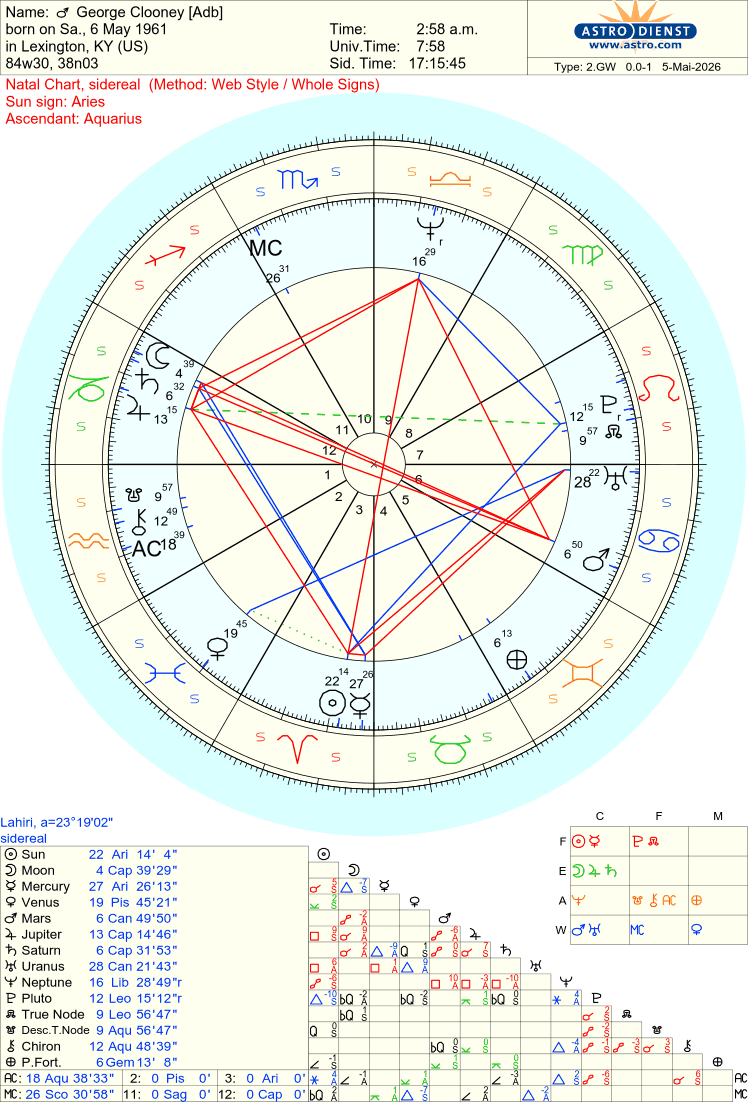
Consider George Clooney’s birth chart in the sidereal zodiac—because using the tropical zodiac would lead to incorrect conclusions. In this case, the Lot of Fortune is in Gemini ☿ in the 5th house ♌. Gemini is ruled by Mercury ☿, which is placed in Aries ♈ in the 3rd house ♊.

The 5th house ♌ placement shows that fortune manifests through creative self-expression, romance, entertainment, and risk-taking — the playground of life where joy, visibility, and personal performance matter. The Gemini ☿ influence colors this fortune with curiosity, adaptability, and communication; opportunities tend to arrive through networking, information, versatility, and clever social maneuvering.

Mercury ☿, as the ruler of Gemini ☿, placed in Aries ♈ in the 3rd house ♊, acts as the vehicle through which this fortune flows. It emphasizes initiative, quick thinking, and intellectual assertiveness. It shows that the fortune Clooney encounters does not land passively; it requires him to take mental action, to communicate, to initiate projects, and to make clever, sometimes bold moves in his immediate environment — siblings, neighbors, local connections, and short journeys — before the larger 5th house opportunities can fully manifest.

In other words, the Lot of Fortune marks the terrain of his luck, but Mercury describes the path through that terrain. Without understanding the ruler, one might see only the “type” of fortune (creative, performative, social) and miss the mechanism by which it operates (active communication, initiative, mental agility).

Source: The Five Places of Life & The Pre-Natal Eclipses: A Complete Guide to the Deeper Architecture of Your Birth Chart

u/Hermes-Astro — 8 days ago

3rd House in Astrology Meaning

The 3rd house is the realm of action, courage, communication, and skill. It reflects how you think, express and move through your environment.

💪 Strength, Courage & Drive

Physical strength and stamina

Courage, bravery, and boldness

Competitive spirit and sportsmanship

Determination and persistence

Effort, grit, and resilience

Work ethic and discipline

The ability to face and handle conflict

Raw energy, drive, and initiative

🗣️ Communication & Expression

Communication style and speech

Voice, articulation, and eloquence

Writing ability and self-expression

Street smarts and practical intelligence

Use of technology (phones, internet, communication tools)

👥 Social Circle & Environment

Younger siblings

Neighbors and local connections

Coworkers in your immediate space

Close friends and your inner circle

Your everyday social environment

🚗 Movement, Travel & Local Life

Short trips and frequent travel

Travel for work or business

Moving within the same country

Local transportation (cars, buses, trains, roads, waterways)

Immediate surroundings and neighborhood

Early learning environments

🎨 Manual Skills

Manual dexterity and hands-on talent

Musical ability (especially instruments)

Craftsmanship and handiwork

🧠 Body Parts & Physical Associations

Arms, shoulders, and hands

Neck and upper chest

Throat and vocal cords

Ears (hearing and balance), especially the right ear

The 3rd house shows how you take action, express yourself, and navigate your immediate world—it’s where courage meets communication and turns into real-life movement.

Sources

The Astrologer's Guide: Mastering Birth Chart Interpretation

House Systems and Derivative Houses in Astrology

u/Hermes-Astro — 9 days ago

1. No Astrology, Please

In the early stages of dating, avoid discussing astrology and zodiac signs. Remember that no one is simply a Leo or Capricorn. This pop language can be misleading. Every person is far more complex than just the Sun in a zodiac sign, and even investigating the entire birth chart may not give you the full picture. A birth chart reading can span hundreds of pages.

2. No Birth Data Requests

Dating should be fun. It’s a meeting of two people who may or may not know anything about each other, simply having a conversation about a wide array of topics and enjoying each other’s company. Even if the relationship progresses, always think of it as temporary. There’s no need to rush, investigate, or calculate compatibility right away.

Similarly, if you’re asked about your birth data, never reveal it. Instead, give a funny answer such as, ‘They found me on a boat on the Mississippi.’

3. No Expectations

It’s normal to have expectations about a life partner, shaped by parents, friends, and society. However, the condition of your marriage are already indicated in your birth chart. You can either be aligned with these indications or not.

Asking questions like age, profession, type of car, and anything else that aims to check off boxes on your expectation list may be only detrimental. Similarly, never answer seriously to those questions in the dating stage.

The ideal dating situation is when you don’t know anything about your partner’s material life conditions, and you decide to be intimate because you are drawn to them for their personality, the way they think, act, talk and make you laugh. Make sure to be drug- or alcohol-free to feel the true attraction energy.

Once you gather some information—such as age, profession, family of origin, and material possessions—you can check if those factors align with your birth chart.

For example, if you discover that your partner is 10 years older than you, but your expectation was for a partner no more than 5-6 years older, then check your 7th house. If Saturn resides there or makes an aspect to it, simply accept it. If you pass up this opportunity, you may have to wait years and still end up with a partner much older than you.

In dating, it’s important to shed any conditioning and focus on having fun. If problems arise later, not understanding astrology may leave you reacting passively throughout the relationship. However, by understanding your birth chart—and your partner’s—you can navigate challenges more effectively.

Remember, challenges are not coincidental; they are already engraved in your birth chart.

4. What Is Sex For?

Elon Musk once said that sex is a “silly action” unless it involves procreation. On the other hand, Rocco Siffredi, an Italian porn star, focuses on orgasm and believes that all women are capable of experiencing it.

There are clitoral orgasms and vaginal orgasms, and in both cases, sensory consciousness dims. That’s why orgasm is linked to the 12th house (loss of consciousness) in astrology.

When the 12th house is afflicted, it can make achieving orgasm more difficult, though this can change over the course of life. So, we tend to agree with Rocco Siffredi: orgasm is for everyone, but it might be elusive at certain periods of life. If problems arise, and partners seek solutions outside the relationship, it may end, but switching partners may not necessarily fix the issue. Understanding temporary challenges with the 12th house can help in making better decisions.

5. The Role of the Man

Shelly Wu’s Chinese Sexual Astrology is a masterpiece of sexual education. In the book, there’s the story of an emperor whose health declined due to overindulgence with his concubines. A Taoist master explained that sex can either be depleting or profoundly restorative, depending on whether the woman reaches orgasm and transfers the yin essence to the man. A woman is more likely to reach orgasm when there is a profound connection and she feels the man’s commitment to helping her achieve it.

>So it’s not that sex without procreation is a “silly action.” It’s that sex without a woman’s orgasm can become a silly action—especially within a stable relationship.

The man’s goal during intercourse is not to achieve his own orgasm, but to help the woman reach at least her first orgasm. And here comes the problem: to bring a woman to orgasm may take anywhere from 20 minutes to more than an hour of intercourse. In today’s fast-paced society, there may not be enough time or relaxation to achieve this. That’s why professions with lower stress levels, such as artists, designers, butchers, landscapers, plumbers, etc., tend to report higher frequencies of orgasm.

Once the woman reaches orgasm, it not only enhances her vitality but also transfers the yin essence to him. The more orgasms the woman experiences, the more essence is transferred to the male, who feels reinvigorated after his own orgasm. A similar dynamic occurs in same-sex couples as well.

In astrology, intercourse is governed by several houses: the 3rd house (arousal), the 7th house (external sexual organs, including the clitoris and the penis), the 8th house (internal sexual organs, including the vagina and the prostate gland), and ultimately the 12th house.

The natal condition of these houses and their transits indicate whether sexual experiences will be smooth or problematic at any give time. For example, Saturn transiting the 3rd house and the South Node transiting the 7th house in a male’s chart may indicate a temporary lack of interest in sex. This doesn’t mean that he no longer cares for his partner—it’s just a passing influence.

To learn more about sex in the birth chart: Astrology and Sex: Secrets to Mind-Blowing Sex

u/Hermes-Astro — 11 days ago

The 2nd house is all about material possessions, resources, and the values that shape your sense of security and self-worth. It also governs how you approach the physical world and how it supports or challenges you.

💰 Material Wealth & Resources

Cash in hand and immediate wealth

Material possessions and valuables

Movable property (cars, electronics, etc.)

Precious items like gold and ornaments

General resourcefulness in managing what you have

💎 Aesthetics, Style & Grooming

Personal style and fashion choices

Aesthetic sense and visual preferences

Personal grooming and care

Tastebuds and eating habits

📝 Documents, Certification & Traditions

Important documents and certificates

Connection to family traditions and cultural beliefs

The values and beliefs passed down from family

Your relationship with tradition and stability

💍 Relationships & Partnerships

Secrets and hidden aspects of marriage or living partnerships

Breakdown of relationships due to material or financial strains

Sarcasm or the tone you use in communication (gentle vs sharp)

👨‍👩‍👧‍👦 Family & Home Life

Family dynamics and relationships

Family values and how they shape your security

Your sense of belonging and comfort with your family

👄 Physical Associations

Mouth, teeth, and tongue

Nose and sense of smell

Right eye (vision and perception of the material world)

The 2nd house touches on your material world, how you interact with wealth, your senses, and the values that shape your life. It reveals how you feel secure, what you value, and how you nurture your physical existence.

Source: The Astrologer's Guide: Mastering Birth Chart Interpretation

u/Hermes-Astro — 13 days ago

As we step into May 2026, the astrology delivers a noticeable energy shift — moving us from the intense, initiatory vibes of early 2026 (Neptune & Saturn in Aries, Uranus freshly in Gemini) into a more grounded, practical, and emotionally clarifying phase.

Key Highlights of May 2026:

  • May 1: Full Moon in Scorpio — A powerful, deeply emotional lunation that illuminates hidden truths, power dynamics, intimacy, and shared resources. Expect intensity around finances, secrets coming to light, and emotional release. This one hits hard and transformative.
  • Taurus Season dominates early/mid-month — With the Sun, Mercury (early on), and later Mars shifting into earthy Taurus energy, the focus turns to stability, body wisdom, values, and slow-but-steady progress. Time to root your ideas in reality and tend to your material world.
  • May 16: New Moon in Taurus — Beautiful for setting intentions around security, self-worth, finances, and sensual pleasures. Plant seeds you want to grow slowly and sustainably.
  • Mid-month shifts — Mercury moves into Gemini, Venus into Cancer, Sun into Gemini (around May 20-23). Communication speeds up, curiosity returns, and emotional needs in relationships become more nurturing.
  • Uranus Cazimi in Gemini (around May 22) — A rare "heart of the Sun" moment for Uranus in its new sign. Sudden insights, breakthroughs in thinking, technology, media, or social connections. Expect the unexpected — innovative ideas that can shake up old patterns.
  • May 31: Blue Moon Full Moon in Sagittarius — The second Full Moon of the month brings adventure, truth-seeking, and big-picture vision. A fiery, expansive closer that encourages spontaneity and honesty.
  • Supporting transits: Pluto stations retrograde early in the month (deepening inner transformation in Aquarius), Mars-Pluto square later (tension between personal action and collective power — stay grounded to avoid power struggles).

Overall Energy Shift:

May feels like a turning point after the rapid changes of April. The vibe shifts from pure disruption and visionary fire toward embodiment and realignment. It's less "everything is exploding" and more "how do I build something real with these new energies?"

  • Themes to work with: Reclaiming your power through practical steps, healing relationship with money/security, honest emotional expression, and balancing depth (Scorpio) with lightness (Gemini/Sag).
  • Advice: Ground yourself — literally. Spend time in nature, move your body, get clear on your values. Avoid scattering energy too early in the month. Use the Taurus New Moon for solid intentions, and ride the Gemini wave with curiosity rather than chaos.

This month has double Full Moons (bookending the energy), offering potent release + culmination portals. Many are reporting it feels like "finally seeing results" or "the fog lifting" after delays.

How are you feeling the shift already?

What house is Taurus activating for you?

Drop your rising sign and experiences below.

Let's navigate this together.

u/Hermes-Astro — 14 days ago

https://preview.redd.it/lif2bj08r9yg1.png?width=540&format=png&auto=webp&s=acf5343aae20dc1ef8482138df039fb4bfc8ab1d

In a recently published Guardian article, the author recounted their experience with dating apps, reflecting on a year spent trying 47 different hobbies in search of a life partner. Despite all their efforts, the goal remained unachieved.

That’s when astrology came into the picture, offering a unique approach to navigating the sometimes chaotic world of love and relationships.

Astrology, with its time-tested wisdom, provides a roadmap to understanding not just who we are, but who we are most likely to attract and how we can best meet them. By investigating the birth chart, astrology can answer crucial questions like:

  • Who are my romantic partners likely to be?
  • Which environments are best for meeting them?
  • When will I meet my partner?

Barack and Michelle Obama: A Cosmic Love Story

Barack Obama Birth Chart - Sidereal* - Astrodatabank: Rating AA

In June 1989, a 28-year-old Barack Obama was a summer associate (intern) at the prestigious Sidley & Austin law firm in Chicago, fresh off his first year at Harvard Law School. Michelle Robinson, then 25, was already a full-time associate at the firm. The firm assigned Michelle to be Barack’s mentor — to show him the ropes, introduce him around, and help him navigate the office culture.

While their professional relationship started as a mentor-mentee dynamic, it quickly blossomed into something far deeper.

Now, let’s look at Barack Obama’s astrological chart to understand why the workplace was the perfect place for him to meet his life partner. In astrology, the 5th house represents romance, dating, and creative self-expression, while the 6th house pertains to work, routine, and service.

For Barack, Jupiter (planet of expansion and opportunity), the Sun ☉ and Mercury ☿, were transiting through his 5th house of romance in June 1989, highlighting a period ripe for romantic opportunities. Meanwhile, his Venus, the ruler of the 5th house and the planet of love and relationships, is placed in the 6th house of work. This suggests that his romantic partner would be found within a work environment, which is exactly what happened when he met Michelle at Sidley & Austin.

So, in Barack’s case, trying to find a partner on dating apps, through hobbies, friends, relatives, or overseas would have been a waste of time and resources. The key to meeting his life partner was aligned with his professional environment — his workplace.

*Please note that we reached this conclusion based on the Sidereal zodiac with the Whole House system. If the Tropical zodiac or a different house system were used, the indications might differ. Therefore, to obtain accurate results, it’s essential to find the correct birth chart settings by matching the transits occurred at significant past events, such as graduation, with the birth chart.

https://preview.redd.it/m5krf93yr9yg1.png?width=700&format=png&auto=webp&s=30fc48c67794234caf701c18a3d1f64dfd5cc2a1

reddit.com
u/Hermes-Astro — 14 days ago
▲ 2 r/u_Hermes-Astro+1 crossposts

In the past—before the Enlightenment (late 17th century)—astrology was a serious discipline intertwined with astronomy, medicine, and psychology, all studied at universities.

Today, anyone can self-proclaim as an astrologer, post content on social media*, and publish books without any real foundation—often simply rehearsing content created by others. That’s why most Western astrology books (and now AI agents such as Claude or ChatGPT) keep repeating the same flaws.

*You can recognize “astrologers for entertainment” because once a planet goes retrograde or changes sign, they promptly make a post.

The Flaws of Western Astrology Books

1) They always suggest using the Tropical Zodiac because “this is what Western astrology uses”

Western astrology books always recommend using the Tropical Zodiac “because this is the system used in Western astrology”. They often mention that the Sidereal Zodiac is used by Vedic astrologers but don’t explain what the Sidereal Zodiac actually is.

In reality, both zodiacs are valid. For some people, the Tropical Zodiac works better; for others, the Sidereal Zodiac is more accurate. Together with the house system (Placidus, Whole, Equal, etc.), the zodiac needs to be chosen before the birth chart reading by matching it to the individual’s personality and life events.

If you’re serious about astrology, study your birth chart using both zodiacs and test different house systems. Use this link on Astro.com. The birth chart settings are not one-size-fits-all, as most Western astrology books claim.

At Hermes Astrology we created a worksheet to help determine which zodiac system and house system apply to the individual. We send this worksheet to our clients before any reading. We don’t simply ask clients for their birth data and then provide a birth chart using a standard zodiac and house system chosen by us, as commercial astrologers do.

2) They misunderstand natal aspects

When you draw a chart on charting websites, they automatically draw lines between planets, usually blue if harmonious and red if disharmonious. This can confuse astrology beginners into believing that aspects are the most important thing when interpreting a birth chart.

In reality, assessing aspects between planets is just the last pillar of planetary analysis. Before this, you need to assess the dignity of the planet, its relationship with its dispositor, the condition of the dispositor, and the position and motion of the planet under assessment.

Once you’ve completed these preliminary steps and have a clear understanding of their condition, you can proceed to analyze the relationship between two planets. Understanding this relationship is like understanding the dynamics in a friendship or partnership. If a friend is troubled on their own, the relationship with you is affected negatively. If both of you are troubled, the situation is even worse.

Then comes the question of energy—whether the planets are compatible, friendly or unfriendly.

In conclusion**,** the relationship between two planets needs to be assessed case by case.

The relationship between two planets is not determined by their angle, as most Western astrology books claims. Again, this is another case of one-size-fits-all thinking, where they claim that sextiles and trines are always good, while squares and oppositions are always bad.

Consider George Clooney’s birth chart:

  • The red lines indicate hard aspects — in Clooney’s case, 6 squares and 4 oppositions.
  • The green dashed line represents 1 quincunx.
  • The blue lines indicate easy aspects — 4 trines and 1 sextile.

If hard aspects always meant struggle and failure, as commercial astrology often implies, wouldn’t Clooney be a poor, frustrated man instead of a successful, admired actor?

3) They misunderstand planetary transits

Once most Western astrology books misunderstand natal aspects, then consequently they misunderstand planetary transits.

The difference between natal planets and planetary transits is that natal planets are fixed in their positions, while planetary transits indicate temporary effects.

Similarly to the previous case, you need to assess whether the planet transiting a sign is happy or not. For example, Saturn transiting Aries is not as happy as Saturn transiting Capricorn, its own sign.

Next, you need to consider which conjunctions and aspects the transiting planet is making with other transiting planets, along with its position on the sign and motion.

Once you understand the condition of the transiting planet, then you can analyze its relationship with the natal planets, if they interact in a friendly or unfriendly manner.

It’s not like most Western astrology books claim, where the result depends solely on the aspect between the transiting planet and the natal planet. There is no one-size-fits-all thinking in astrology.

u/Hermes-Astro — 14 days ago

In the past—before the Enlightenment (late 17th century)—astrology was a serious discipline intertwined with astronomy, medicine, and psychology, all studied at universities.

Today, anyone can self-proclaim as an astrologer, post content on social media*, and publish books without any real foundation—often simply rehearsing content created by others. That’s why most Western astrology books (and now AI agents such as Claude or ChatGPT) keep repeating the same flaws.

*You can recognize “astrologers for entertainment” because once a planet goes retrograde or changes sign, they promptly make a post.

The Flaws of Western Astrology Books

1) They always suggest using the Tropical Zodiac because “this is what Western astrology uses”

Western astrology books always recommend using the Tropical Zodiac “because this is the system used in Western astrology”. They often mention that the Sidereal Zodiac is used by Vedic astrologers but don’t explain what the Sidereal Zodiac actually is.

In reality, both zodiacs are valid. For some people, the Tropical Zodiac works better; for others, the Sidereal Zodiac is more accurate. Together with the house system (Placidus, Whole, Equal, etc.), the zodiac needs to be chosen before the birth chart reading by matching it to the individual’s personality and life events.

If you’re serious about astrology, study your birth chart using both zodiacs and test different house systems. Use this link on Astro.com. The birth chart settings are not one-size-fits-all, as most Western astrology books claim.

At Hermes Astrology we created a worksheet to help determine which zodiac system and house system apply to the individual. We send this worksheet to our clients before any reading. We don’t simply ask clients for their birth data and then provide a birth chart using a standard zodiac and house system chosen by us, as commercial astrologers do. You can get this worksheet separately. Link in bio.

2) They misunderstand natal aspects

When you draw a chart on charting websites, they automatically draw lines between planets, usually blue if harmonious and red if disharmonious. This can confuse astrology beginners into believing that aspects are the most important thing when interpreting a birth chart.

In reality, assessing aspects between planets is just the last pillar of planetary analysis. Before this, you need to assess the dignity of the planet, its relationship with its dispositor, the condition of the dispositor, and the position and motion of the planet under assessment.

Once you’ve completed these preliminary steps and have a clear understanding of their condition, you can proceed to analyze the relationship between two planets. Understanding this relationship is like understanding the dynamics in a friendship or partnership. If a friend is troubled on their own, the relationship with you is affected negatively. If both of you are troubled, the situation is even worse.

Then comes the question of energy—whether the planets are compatible, friendly or unfriendly.

In conclusion**,** the relationship between two planets needs to be assessed case by case.

The relationship between two planets is not determined by their angle, as most Western astrology books claims. Again, this is another case of one-size-fits-all thinking, where they claim that sextiles and trines are always good, while squares and oppositions are always bad.

Consider George Clooney’s birth chart:

  • The red lines indicate hard aspects — in Clooney’s case, 6 squares and 4 oppositions.
  • The green dashed line represents 1 quincunx.
  • The blue lines indicate easy aspects — 4 trines and 1 sextile.

If hard aspects always meant struggle and failure, as commercial astrology often implies, wouldn’t Clooney be a poor, frustrated man instead of a successful, admired actor?

3) They misunderstand planetary transits

Once most Western astrology books misunderstand natal aspects, then consequently they misunderstand planetary transits.

The difference between natal planets and planetary transits is that natal planets are fixed in their positions, while planetary transits indicate temporary effects.

Similarly to the previous case, you need to assess whether the planet transiting a sign is happy or not. For example, Saturn transiting Aries is not as happy as Saturn transiting Capricorn, its own sign.

Next, you need to consider which conjunctions and aspects the transiting planet is making with other transiting planets, along with its position on the sign and motion.

Once you understand the condition of the transiting planet, then you can analyze its relationship with the natal planets, if they interact in a friendly or unfriendly manner.

It’s not like most Western astrology books claim, where the result depends solely on the aspect between the transiting planet and the natal planet. There is no one-size-fits-all thinking in astrology.

u/Hermes-Astro — 16 days ago

The 1st house is all about you—your physical form, your presence, and the way you meet the world. It shapes both how you see yourself and how others experience you.

🧍‍♂️ Physical Appearance & Body

  • Your physical body and overall build
  • Skin tone and complexion
  • General constitution and vitality
  • Facial structure and features
  • Hair and eyebrows
  • Marks like scars, moles, and birthmarks
  • The brain and head as a whole

💫 Energy, Presence & Vibe

  • Your natural confidence
  • Life force, vitality, and aura
  • The energy you carry into a room
  • Your immediate presence
  • The first impression you leave on others

🧠 Personality & Inner Self

  • Your core personality traits
  • Your authentic, instinctive self
  • Your inner self-image
  • The way you perceive yourself
  • Your personal mindset and outlook

🌍 Identity & Self-Expression

  • Your personal identity
  • Your “brand” or how you present yourself
  • Your personal style and outward expression
  • Your core values
  • The lens through which you view the world

The 1st house is essentially your starting point—it’s where identity, body, and perception all come together to form you as an individual.

Source: House Systems and Derivative Houses in Astrology

u/Hermes-Astro — 16 days ago

The 3rd house is the realm of action, courage, communication, and manual skills. It reflects how you think, express and move through your environment.

💪 Strength, Courage & Drive

  • Physical strength and stamina
  • Courage, bravery, and boldness
  • Competitive spirit and sportsmanship
  • Determination and persistence
  • Effort, grit, and resilience
  • Work ethic and discipline
  • The ability to face and handle conflict
  • Raw energy, drive, and initiative

🗣️ Communication & Expression

  • Communication style and speech
  • Voice, articulation, and eloquence
  • Writing ability and self-expression
  • Street smarts and practical intelligence
  • Use of technology (phones, internet, communication tools)

👥 Social Circle & Environment

  • Younger siblings
  • Neighbors and local connections
  • Coworkers in your immediate space
  • Close friends and your inner circle
  • Your everyday social environment

🚗 Movement, Travel & Local Life

  • Short trips and frequent travel
  • Travel for work or business
  • Moving within the same country
  • Local transportation (cars, buses, trains, roads, waterways)
  • Immediate surroundings and neighborhood
  • Early learning environments

🎨 Manual Skills

  • Manual dexterity and hands-on talent
  • Musical ability (especially instruments)
  • Artistic expression (drawing, painting, sculpting)
  • Craftsmanship and handiwork

🧠 Body Parts & Physical Associations

  • Arms, shoulders, and hands
  • Neck and upper chest
  • Throat and vocal cords
  • Ears (hearing and balance), especially the right ear

The 3rd house shows how you take action, express yourself, and navigate your immediate world—it’s where courage meets communication and turns into real-life movement.

u/Hermes-Astro — 17 days ago