
What exactly is the ""honest work" when it comes to sprinting? (4 min read)
“Just put in the work.”
It’s one of the most common phrases we hear in sport, and I’d argue one of the least helpful.
Because when it comes to speed development, many athletes are sure as hell working hard. They’ve just started a new gym programme. They’re doing their warm-ups A and B drills. They’re hitting their plyos. They’re getting in their core conditioning. They’re trying right?
But why are these athletes still googling “why am I not getting any faster?” behind their coaches back.
This is not because they lack the discipline - but because they misunderstand what the work actually is.
The reality is that speed development is not built through random effort or by accumulating as much fatigue as possible. Sprint performance is built through the repeated accumulation of highly specific adaptations (which we won’t go into right now) and layered over months and years.. until the body becomes better organised for the task of sprinting.
--
At its core, sprinting is the ability to produce and direct force into the ground in the right direction, at the right magnitude, in the right position, within incredibly short contact times.
During maximal velocity sprinting, ground contact times in trained athletes can be as low as ~0.09–0.12 seconds.. that’s a pretty small window for athletes to coordinate:
- Limb exchange velocity
- Vertical and horizontal force application
- Segmental stiffness
- Trunk and pelvic control
- Strike timing and positioning
This is why sprinting cannot be reduced to isolated components.
You cannot separate “limb velocity” from force production.
You cannot separate “stiffness” from mechanics.
These qualities all exist together. So, athletes trying to train these qualities as if they exist separately without understanding how they interact in the full sprinting task, often ends up spending enormous time on work that has minimal transfer.

So, what is the HONEST WORK.
1) Actually sprinting.
One of the biggest misconceptions in sprint training is that drills can substitute for sprint exposure. They really cannot.
I am not saying drills are useless, I use them all the time! What I’m saying is sprinting is an extremely velocity-specific, force-specific, and time-constrained task.
At maximal velocity, ground contact times are typically in the region of ~0.08–0.12 seconds in trained athletes (Mero, Komi; Weyand et al.,). Within that window, the athlete must produce large forces often exceeding 2–4x bodyweight, while coordinating rapid limb exchange and maintaining stiffness through the entire kinetic chain. This combination of force magnitude, direction, and timing is truly unique to sprinting at high speeds.
It cannot be replicated at sub maximal velocities. And it cannot be replicated through isolated drills.
As Frans Bosch has argued extensively, movement solutions emerge through interaction with the actual task.. not through endless decomposition of the task into disconnected parts. You do not learn to sprint faster by rehearsing sprint-like positions. You learn to sprint faster by sprinting fast, often enough, for long enough.
I’ll dive deeper into true maximal velocity training on another post.
2) Actually sprinting, often.
One of the greatest mistakes in self-coached athletes is assuming adaptation comes from isolated “hard sessions” every now and then. It sadly doesn’t. There is in fact no athletic ability in which humans reach an elite level by just doing that skill a small amount of times per week.
Speed is built from chronic exposure. We have to remember that the body adapts to the cumulative dose of high-quality sprinting over time.
This requires intelligent progression of all things like, total sprint contacts, acceleration volume, max. velocity exposure, speed endurance density and so on.. Just like hypertrophy and strength is built through progressive overload in the gym, sprint development requires progressive exposure to sprint-specific outputs. Research consistently shows sprint performance is highly sensitive to training history and long-term exposure.
So, yes of course, athletes CAN make significant improvements in 6 weeks.. but to create consistent speed that the athlete can trust their bodies have access to - it is layered over years of repeated sprinting.
HOW MUCH VOLUME? Well, the answer is hugely contextual. I believe there are many different and successful paths to sprint development. Some sprinters can thrive off of high volumes of work whilst others appear to respond better to lower volumes at higher intensities. There is a huge variation between athletes in terms of the training they do, yet they sometimes arrive at very similar results if they’ve truly been consistent over time. So, this is a question again, I will tackle in a later post.
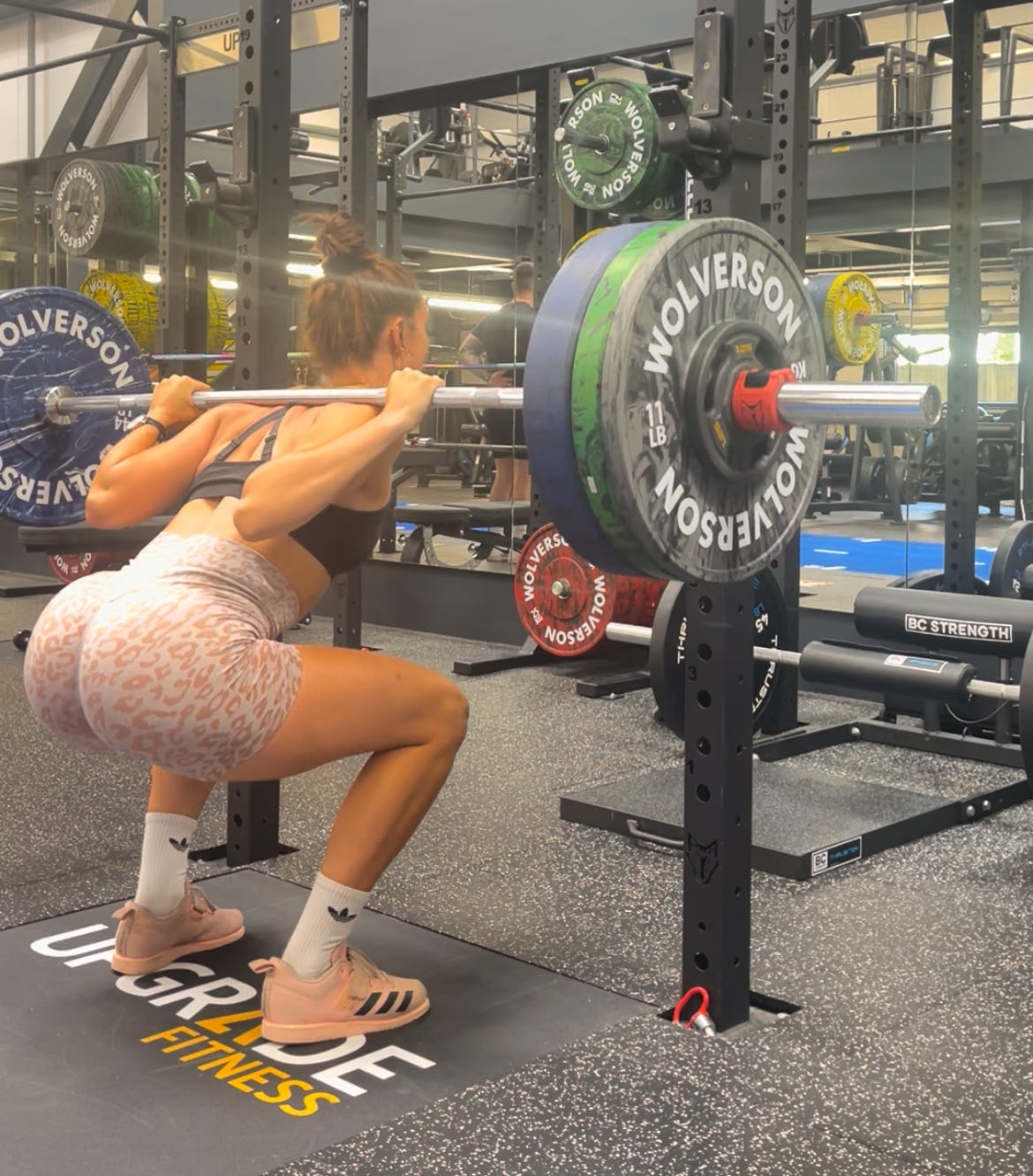
3) The supporting act: Lifting.
Sprinting places huge demands on force production. Not just the ability to produce force, but to produce it rapidly, in the right direction, and within extremely short contact times.
Strength training can improve maximal force output, increase relative strength, enhance rate of force development, and contribute to greater tendon stiffness and force absorption capacity. These adaptations matter because they raise the ceiling of what an athlete is physically capable of producing. They give the system more potential.
However, it’s a grey area and quite complex, but ultimately sprinting definitely increases force production for sprinting. Strength training, regardless of specificity MAY OR MAY NOT increase force production - it depends.
One of the most common mistakes in strength and conditioning is assuming that increasing this capacity will automatically improve sprint performance. If it did, the strongest athletes in the gym would always be the fastest on the track? But they aren’t.
For me, the missing piece is transfer. Strength only matters to the extent that it can be expressed within the specific constraints of sprinting. That depends on context. Is force production actually the athlete’s limiting factor, or is it coordination, timing, or technical organisation?
Has the athlete already reached a level of “enough” strength where further gains have diminishing returns? And critically thinking, is there enough sprint exposure for the body to learn how to use that strength under real conditions?! This is why context matters - always.
The key is understanding that strength work is primarily about driving physiological adaptations, not directly improving sprint performance in isolation.
Strength training contributes to sprint performance by improving the system at a tissue and neuromuscular level. Over time, it can lead to, increased cross-sectional area of muscle (greater force potential), improved motor unit recruitment and firing frequency, greater tendon stiffness (improving force transmission and elastic return), changes in fascicle length (particularly in muscles like the biceps femoris).
These are real, measurable adaptations. And importantly, many of them are difficult to develop through sprinting alone, especially in less trained athletes.
These adaptations are necessary, but not sufficient. They give the athlete the only the potential to sprint faster. They do not guarantee that they will. This is important to understand. Because sprinting performance depends on how well those qualities are coordinated and expressed within the specific constraints of sprinting.
So yes, strength training is hugely valuable for the physiological side of the equation.
The mistake is treating it as the main event, rather than what it actually is: A powerful support system that only becomes meaningful when it’s paired with consistent, high-quality sprint exposure.

4) The supporting act: Jumping.
Plyometrics and jumping exercises’ value lies deep in the physiological adaptations they drive within the muscle–tendon system.
At their core, plyometrics expose the body to high rates of force production and rapid stretch-shortening cycle (SSC) demands - you could argue it’s much closer to what sprinting actually requires than traditional strength training. Over time, this leads to adaptations such as increased tendon stiffness, improved elastic energy storage and return, and a greater ability to produce force quickly within very short ground contact times.
A stiffer tendon, for example, allows force to be transmitted more efficiently from muscle to bone, reducing energy loss and improving ‘reactivity’. Sprinting is not allllll muscular effort.
There are also changes in how the system behaves as a whole. Plyometrics can improve the body’s ability to tolerate, absorb, and reapply force effectively, which not only supports performance but also builds resilience in tissues like the Achilles tendon and hamstrings. Over time, the athlete shifts more toward what I call an elastic strategy - where movement becomes less about producing force from scratch and more about efficiently recycling it.
These adaptations exist at the level of potential, similar to strength training. They improve the system, but they don’t organise it. Plyometrics don’t teach the athlete how to apply force in the exact orientation, timing, and coordination required for sprinting. They enhance the qualities that underpin performance, but the expression of those qualities still depends on sprint exposure.
And this is where a lot of athletes go wrong.. not in doing plyometrics, but in how they use them. Plyometrics should be progressed and periodised with intent.
Early on, or with less experienced athletes, they often take on a more extensive role. Lower intensity, higher contact volumes, and simpler variations help build tissue tolerance and baseline stiffness. This is preparation or “building the base”.
As training progresses, plyometrics should become more intensive. Contact times shorten, intent increases such as trying to jump higher, and exercises begin to more closely reflect the demands of sprinting. The focus shifts toward maximising elastic return and minimising time on the ground - qualities that directly support maximal velocity running. But even at this stage, they are still the supporting act.
They should complement high-intensity days, not compete with them, which is why periodisation is hugely important. They should be dosed in a way that allows the athlete to stay fresh enough to actually sprint well.
5) Recovery (the one no one wants to hear about)
This is the part that doesn’t sell and it’s really not that exciting.
It doesn’t look like “work.” BUT, it’s pretty darn important if you consider this: all your sprinting, lifting, jumping is effectively useless if the body doesn’t have the chance to actually adapt to it.
Speed development is heavily dependent on the nervous system. High-quality sprinting requires high output and fresh tissues that can produce and absorb force effectively. When you keep accumulating fatigue - those qualities are the first to drop.
= Ground contact times get longer = Force output decreases = Mechanics become less efficient = Injury risks
This is where a concept like supercompensation becomes useful to understand as a guiding principle.
After any training stimulus, performance doesn’t immediately improve. It will drop first, as fatigue accumulates. Then, if you give yourself enough recovery, the body then adapts and rebounds above its previous baseline - this is the “supercompensation” phase. But that window is very temporary. If the next stimulus comes around too early, you just keep stacking on fatigue. But, if it comes too late, you lose the adaptation.
Speed development lives and dies in this timing.
Because sprinting is so neurologically demanding, the cost of mistiming this cycle is high. If athletes constantly train in a fatigued state.. layering sprint sessions, gym work, and plyometrics without adequate recovery.. they never fully realise that rebound effect. They’re always training in the dip, never expressing the peak.
And now, instead of reinforcing the qualities you’re trying to build, you’re rehearsing something else entirely. Sometimes the most productive thing you can do is not add more variety, more exercises, or more sessions but to protect the quality of the work you’re already doing.
Recovery CAN be both physical and mental. Besides all the obvious recovery tools like: sleep, nutrition, hydration, breath work, circadian health, active recovery, sauna/ice, myofasical release etc.
For some athletes, the recovery just needs to be something that helps them to slow down, a chance to really switch off and tune into their quieter mind. I personally see such a positive impact on the athletes I coach when I programme a recovery session that looks like a mix of mobility, active recovery (walking), and breathwork. It’s not fancy.. in my eyes as a coach, if an athlete can recovery well and move freely in their body, they’re already in a great place, because a body that can recover well creates a mind that can perform well.
If you need any inspo for mobility recovery sessions - here is my latest YouTube video follow along.

When we zoom out, this is what the honest work really looks like.
It’s not constantly changing things. It’s doing the right things, again and again with enough precision and quality. And enough patience for them to actually transfer.