
I built an AI assistant that lets non-technical teams query APIs using natural language — fully self-hostable
Hey r/StartupSoloFounder 👋
I'm a Java developer working in insurance (yes, legacy systems, yes, WebSphere — I've seen things). For years I watched business teams struggle to get data out of internal APIs. They'd file tickets, wait days, and still get the wrong report. Meanwhile, the API docs were right there in Swagger files that nobody outside engineering could read.
So I built Alesqui Intelligence — an AI assistant where you upload your Swagger/OpenAPI spec and it generates a conversational agent that can discover, call, and explain your APIs in natural language.
What it does
- You upload your Swagger/OpenAPI spec (and optionally a Postman Collection to enrich context with examples)
- The system parses and unifies them into a single knowledge base
- Users chat in natural language → the AI agent figures out which endpoints to call, executes them, and streams back the answer with step-by-step reasoning
- It can also filter, aggregate, generate charts, and export to Excel
- Fully responsive — works on desktop and mobile, so field teams can query APIs from their phone
- Full RBAC: admins control which teams see which APIs
The "why should I care" version
Think of it as "ChatGPT but it actually talks to your company's APIs" — except it's self-hosted, so your data never leaves your infrastructure.
🎬 Quick demo: https://www.youtube.com/watch?v=dRJc_Pn4Ypo
Tech stack
- Backend: Java 21, Spring Boot 3.5, WebFlux (fully reactive), Spring AI 1.0
- AI: ReAct pattern with tool calling (LLM-agnostic, currently using GPT-4o-mini)
- Database: MongoDB 7.0 with Reactive Streams
- Frontend: React 19
- Auth: JWT + RBAC (3 roles: SuperAdmin, IT, Business)
- Deployment: Docker multi-stage builds, self-hosted or cloud trial
Architecture
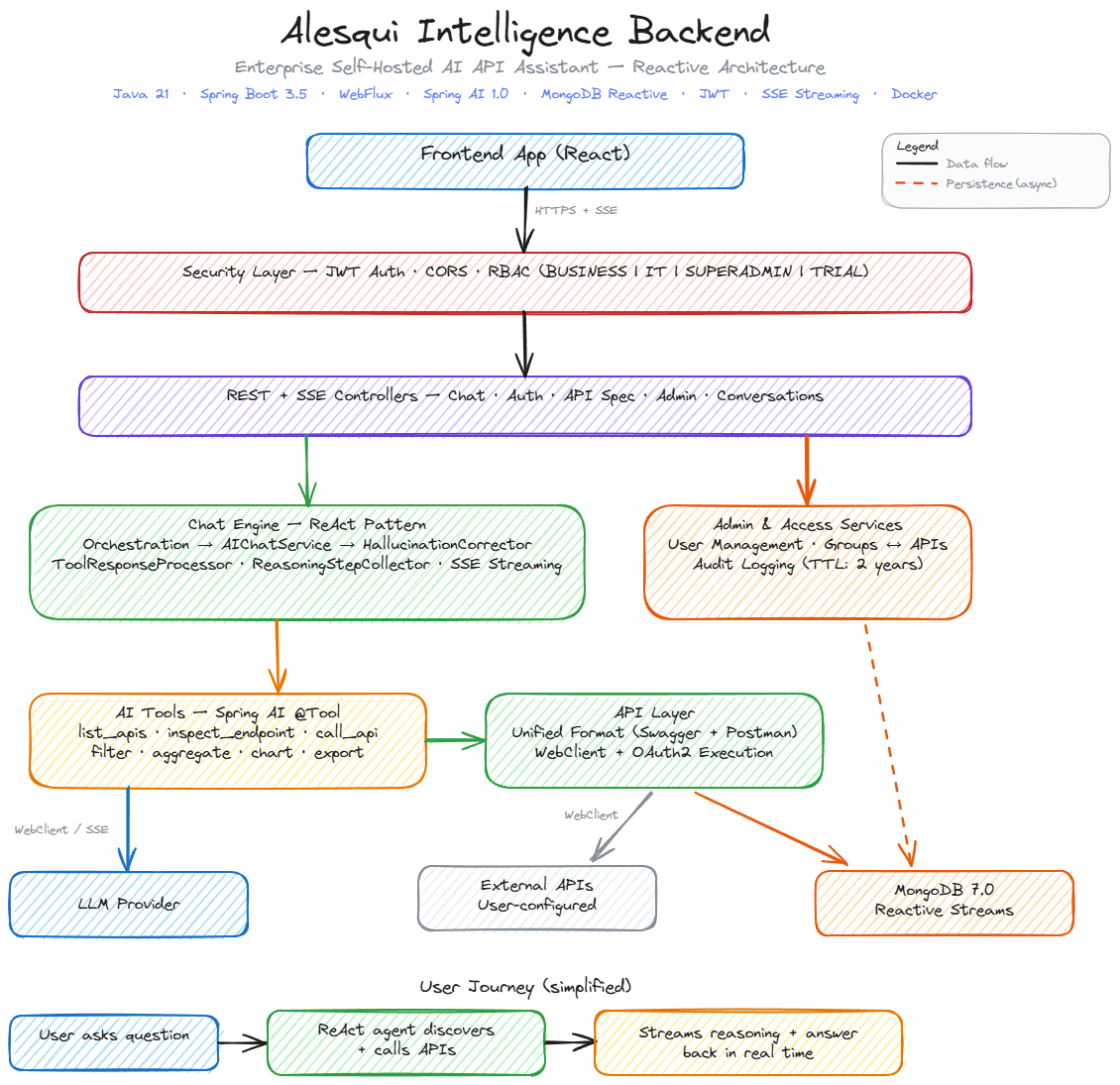
The backend follows a reactive pipeline end-to-end. When a user sends a message, it hits the Chat Engine which orchestrates a ReAct loop — the AI reasons about which tools to use (list_apis, inspect_endpoint, call_api, filter, aggregate, chart, export), executes them, and streams the reasoning steps back via SSE. This means users see what the AI is doing in real time, not just the final answer.
Some things I learned building this
- Spring AI's Tool abstraction is genuinely great. Defining tools as annotated methods and letting the framework handle the function-calling protocol saved me weeks. The ReAct loop basically writes itself once your tools are well-defined.
- Reactive + SSE is the right call for AI streaming. WebFlux with SSE gives you backpressure for free. When the AI is thinking, the client sees real-time "STATUS" events with each reasoning step. It transforms the UX from "waiting for a black box" to "watching the agent work."
- The "Unified Format" abstraction was key. Supporting both Swagger and Postman meant I needed a common internal representation. This also made the AI's job easier — instead of dealing with format-specific quirks, it reasons about a clean, normalized API definition.
- Enterprise features aren't optional, even for side projects. If you want companies to actually deploy your tool, you need audit logging, RBAC, password reset flows, and deployment modes from day one. I built both a CORPORATE mode (admin manages users) and a TRIAL mode (self-registration with 14-day expiry).
Current status
- Cloud trial is live (you can sign up and test with your own Swagger files)
- Self-hosted distribution package available via Docker Compose
- Landing page: alesqui.com
- Source code:
What's next
I'm exploring adding support for multiple LLM providers configurable by the admin from the dashboard — so companies locked out of OpenAI by policy can still use the platform. Also planning a usage analytics layer with cost tracking per team, so admins can monitor API calls, LLM token consumption, and justify ROI internally.
Feedback welcome
I'd love to hear your thoughts — on the architecture, the product, the approach, anything. If you work with internal APIs and this resonates, I'd especially love to know what features would make this useful for your team.
Thanks for reading! Happy to answer any questions.